Descuento:
-5%Antes:
Despues:
177,83 €1. Should
2. How to Train as a VR Surgeon Outside a Formal Fellowship
3. Fundamental Rules for the VR Surgeon
4. Frequently Asked Questions About the Basics of VR Surgery
5. The VR Surgeon’s Relation to His Patient: Counseling
6. The VR Surgeon’s Relation to His Nurse
7. Examination
8. The Indication Whether to Operate
9. The Indication When to Operate (Timing)
10. The Order of Cases If Multiple Surgeries Are Performed
11. The Surgeon’s Relation to Himself
12. Major Equipment, Their Accessories and Use
13. Instruments, Tools, and Their Use
14. Materials and Their Use
15. Anesthesia
16. The Surgeon at the Operating Table
17. Vitrectomy Performed via the “Standard” Method and Its Alternatives
18. Disinfection, Draping, and Perioperative Medications
19. The Speculum and Its Placement
20. Holding and Operating Hand Instruments
21. Sclerotomies and the Cannulas
22. Illumination
23. The Checklist Before the First Cut with the Probe
24. Using the Vitrectomy Probe
25. Maintaining Good Visualization
26. Anatomy and Physiology: What theVR Surgeon Must Know
27. The Basics of Vitreous Removal
28. Scleral Indentation
29. Cryopexy
30. Endolaser
31. Working With and Under Air
32. Working with Membranes
33. Retinectomy, Retinotomy, and Chorioretinectomy
34. Chromovitrectomy
35. Tamponades
36. Submacular Hemorrhage
37. Subretinal Biopsy
38. Combined Surgery
39. AC Basics
40. Handling of Major Intraoperative Complications
41. Pediatric Patients
42. The Highly Myopic Eye
43. Intravitreal Injections
44. Dropped Nucleus and Dislocated IOL
45. Endophthalmitis
46. Floaters
47. Hyphema
48. Iris Abnormalities
49. Macular Disorders: Edema
50. Macular Disorders Related to Traction: VMTS, Cellophane Maculopathy, EMP, Macular Hole
51. Optic Pit
52. PDR
53. PVR
54. Retinal Detachment
55. RD, Tractional and Combined
56. RD, Central
57. Retinoschisis
58. RVO
59. Scleroplasty
60. Suprachoroidal Hemorrhage
61. Uveitis, Posterior
62. Vitreous Hemorrhage
63. Trauma
64. Postoperative Care
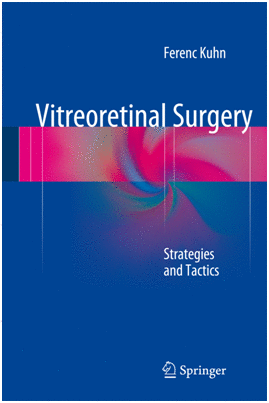
This book is exceptional in explaining not only when and how but also why vitrectomy is performed – an additional focus that will help trainee surgeons to develop their own critical thinking. Uniquely, the book’s first part describes “the life of the vitreoretinal surgeon” to help residents decide whether the field is indeed suitable for them, and if yes, how they can chart their own course in the absence of a formal fellowship program.
The second and third parts discuss the fundamentals in VR surgery, such as the general philosophy underlying vitrectomy, equipment, examination, timing, anesthesia, the surgeon’s posture, and the organization of the operating room. The final two parts are dedicated to surgical strategy and tissue tactics, reviewing the principles of surgical maneuvers and the practical sides of diagnosis-specific issues. An appendix is also included, which offers additional guideposts for the aspiring trainee surgeon, including a description of how an ideal mentor should act in surgery. The book is written in an easy-to-follow format with bullet points and text boxes, and has well over 250 color images and line drawings as well as over 60 tables.
Features
• Explains not only when and how but also why vitrectomy is performed
• Clarifies the author’s personal preferences for specific indications
• Addresses larger issues, not only technical details
• Identifies differences between surgery on the anterior and posterior segments
• Includes numerous line drawings and color intraoperative photos
Author
Ferenc Kuhn, MD, PhD, is an ophthalmologist/vitreoretinal specialist whose primary research interest is ocular trauma, in which he is a renowned leader worldwide. He is the Immediate Past President of the American Society of Ocular Trauma and current President of the International Society of Ocular Trauma. Dr. Kuhn is Associate Professor of Clinical Ophthalmology at the University of Alabama at Birmingham and Visiting Professor at the European University, Belgrade, Serbia. His past positions include Director of Clinical Research for the Helen Keller Foundation for Research and Education (Jacksonville, FL, USA). During the 1990s Dr. Kuhn and his colleagues revolutionized surgery of the macula, proving that traction maculopathy is best treated by removing the diseased surface layer of the macula, and standardized the language of ocular trauma (the Birmingham Eye Trauma Terminology, BETT, endorsed by the leading ophthalmologic societies worldwide). Dr. Kuhn also developed the only objective method to prognosticate the likely outcome of a serious eye injury (Ocular Trauma Score, OTS). He has twice received the R. Buckler Award from the American Society of Retina Specialists and is the recipient of Senior Achievement Awards from the American Society of Retina Specialists and the American Academy of Ophthalmology. Dr. Kuhn has delivered more than 1,600 scientific presentations on vitreoretinal surgery and ocular trauma at international, national, and regional meetings. He has edited four books, including, in 2008, the Springer book Ocular Traumatology, in which he was the principal author and which has since been translated into multiple languages. In addition he has written 91 book chapters in 29 books and 137 scientific articles.
 -5%
-5%
 -5%
-5%
 -5%
-5%
 -5%
-5%
 -5%
-5%
 -5%
-5%
 -5%
-5%
 -5%
-5%
 -5%
-5%
 -5%
-5%