Descuento:
-5%Antes:
Despues:
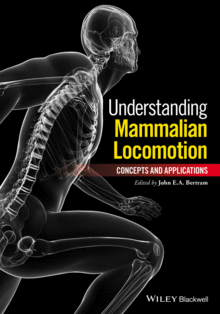
160,06 €Understanding Mammalian Locomotion will formally introduce the emerging perspective of collision dynamics in mammalian terrestrial locomotion and explain how it influences the interpretation of form and functional capabilities. The objective is to bring the reader interested in the function and mechanics of mammalian terrestrial locomotion to a sophisticated conceptual understanding of the relevant mechanics and the current debate ongoing in the field.
Author
John E.A. Bertram is a Professor in the Department of Cell Biology and Anatomy, Cumming School of Medicine, and adjunct Professor in the Department of Comparative Biology and Experimental Medicine, Faculty of Veterinary Medicine, at the University of Calgary in Calgary, AB, Canada.
Table of Contents
1 Concepts Through Time: Historical Perspectives on Mammalian Locomotion 1
2 Considering Gaits: Descriptive Approaches 27
3 Muscles as Actuators 51
4 Concepts in Locomotion: Levers, Struts, Pendula and Springs 79
5 Concepts in Locomotion: Wheels, Spokes, Collisions and Insight from the Center of Mass 111
6 Reductionist Models of Walking and Running 143
7 Whole ]Body Mechanics: How Leg Compliance Shapes the Way We Move 173
8 The Most Important Feature of an Organism’s Biology: Dimension, Similarity and Scale 193
9 Accounting for the Influence of Animal Size on Biomechanical Variables: Concepts and Considerations 229
10 Locomotion in Small Tetrapods: Size ]Based Limitations to “Universal Rules” in Locomotion 251
11 Non ]Steady Locomotion 277
12 The Evolution of Terrestrial Locomotion in Bats: the Bad, the Ugly, and the Good 307
13 The Fight or Flight Dichotomy: Functional Trade ]Off in Specialization for Aggression Versus Locomotion 325
14 Design for Prodigious Size without Extreme Body Mass: Dwarf Elephants, Differential Scaling and Implications for Functional Adaptation 349
15 Basic Mechanisms of Bipedal Locomotion: Head ]Supported Loads and Strategies to Reduce the Cost of Walking 369
16 Would a Horse on the Moon Gallop? Directions Available in Locomotion Research (and How Not to Spend Too Much Time Exploring Blind Alleys) 385
Index 393
 -5%
-5%
 -5%
-5%
 -5%
-5%
 -5%
-5%
 -5%
-5%
 -5%
-5%
 -5%
-5%
 -5%
-5%
 -5%
-5%
 -5%
-5%