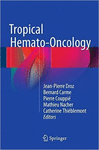
DROZ, J. P.; CARME, B.; COUPPIÉ, P.; NACHER, M.; THIÉBLEMONT, C.
Descuento:
-5%Antes:
Despues:
118,55 €What should you do when you have restricted resources? Written by the most prominent experts from the North and the South countries, this book offers a unique complement to classical hematology and oncology textbooks focusing on specific issues concerning cancers in tropical areas. It presents a thorough review of the specific biological, clinical and therapeutic characteristics of cancers in tropical areas, including their background and epidemiology, public health consequences and transcultural mediation. As such, it will be a valuable resource for all hemato-oncology practitioners, students of oncology or tropical medicine, and other physicians involved in the care of cancer patients who live in tropical countries.
Feature
- This book draws from an international pool of North and South expert contributors
- A unique book which addresses the very specific issues in treating cancer in the tropical areas
- Provides the reader with the big picture in tropical hematology and oncology
- Designed as a "field" guide with practical recommendations to be used by physicians with limited means
Authors
Jean-Pierre Droz was formerly Chairman of the Department of Medicine at the Institut Gustave-Roussy, Villejuif and at the Centre Léon-Bérard in Lyon (France). Since January 2010 he is a physician of medical oncology at the University Hospital in Cayenne (French Guiana) and is teaching at the French Guiana and West Indies University Medical School. His major subjects of clinical research are Genito-Urinary tumors, Germ-Cell Tumors and Prostate Cancer, Geriatric Oncology and Endocrine Tumors medical treatment.
Bernard Carme is a Professor of medicine, specialist in Parasitology and of tropical medicine, Pitié Salpétrière University Hospital, University of Paris VI (France), University Hospital and Faculty of Medicine in Brazzaville, Republic of Congo. Since 1996, he is the head department in Cayenne university Hospital (French Guiana) and Professor at the Medical School, French West Indies and French Guiana University.
Pierre Couppié is a Professor of Dermatology at the French Guiana and West Indies University Medical, head of the service of Dermatology and Chairman of the Department of Medicine at the Cayenne University Hospital since 1997.
Mathieu Nacher is a Professor of Epidemiology and Public Health at the French Guiana and West Indies University Medical School. He is the director of the French Guiana and West Indies Clinical Investigation Center. His main focus of interest is the interactions between nematode infections and malaria, and HIV epidemiology.
Catherine Thiéblemont is a Professor of Hematology in the Paris VII- University, France – and the head of the Hemato-Oncology Department in the Hospital Saint-Louis, which is dedicated to the management of patients with lymphoma, with more than 400 patients newly diagnosed and managed per year (Paris, France since December 2009). She is an active member of the Lymphoma Study Association (LYSA) and of the International extranodal Lymphoma study group (IELSG).
Table of contents (58 chapter)
1.Oncology in the Concept of Tropical Medicine: To Be or Not to Be?
2.The Health Needs of People in Tropical Countries, Growth of Malignant Diseases and Coexistence of Extremes
3.Epidemiology of Cancer in the Tropical Areas
4.Cancer Control in the Tropical Areas, Access to Expensive Treatments, and Ethical Considerations
5.Precarity, Social Organization, and Outcome on Cancer Management in the Tropical Areas
6.Cancer Screening and Prevention in the Tropics
7.Pathology and Cancer Research
8.Transcultural Mediation in the Management of Cancer Patients in the Tropical Area
9.Cancer Clinical Trials in the Tropical Area
10.The Spectrum of Infectious Disease-Related Cancers
11.Epidemiology and Mechanism of Carcinogenesis of the Retrovirus HIV
12.Human T-Cell Leukemia Virus Type 1: Epidemiological Aspects
13.Epidemiology and Mechanism of Carcinogenesis of the Virus HBV
14.Hepatitis Virus Scientific Background: Epidemiology and Mechanism of Carcinogenesis of Hepatitis C Virus (HCV)
15.Epidemiology of Epstein-Barr Virus and Mechanisms of Carcinogenesis
16.HPV and Cancer: Epidemiology and Mechanism of Carcinogenesis of the Virus HPV
17.Human Herpesvirus-8 (HHV-8) and Cancers: Scientific Background, Epidemiology, and Carcinogenesis of the Virus
18.Epidemiology and Mechanism of Carcinogenesis of Schistosomiasis
19.Epidemiology of
20.Adult T-Cell Leukaemia/Lymphoma (ATL)
21.Extranodal NK/T Cell Lymphoma, Nasal Type
22.Diagnosis of Diffuse Large B-Cell Lymphoma
23.Burkitt’s Lymphoma: Physiopathology and Treatment of EBV-Associated Lymphomas
24.Mantle Cell Lymphoma
25.Indolent Lymphomas: Follicular Lymphoma, HVC-Associated Marginal Zone B-Cell Lymphoma, and Waldenstrom’s Macroglobulinemia
26.Myeloproliferative Neoplasms
27.The Myelodysplastic Syndromes
28.Acute Leukemia
29.Breast Cancer
30.Cervical Cancer
31.Cancer of the Oesophagus
32.Gastric Carcinoma in Developing Countries
33.Colorectal Cancer
34.Hepatocellular Carcinoma
35.Cholangiocarcinoma
36.Pancreatic Cancer
37.Lung Cancer
38.Head and Neck Cancers
39.Bladder Cancer: A Perspective for Tropical Regions
40.Prostate Cancer
41.Renal Cancer
42.Cutaneous Cancers (Including Melanoma)
43.Epithelial Ovarian Cancer
44.Endometrial Cancer
45.Cancer of the Penis, Anus, and Vulva
46.Gestational Trophoblastic Diseases
47.Central Nervous System Tumors
48.Thyroid Cancer
49.Uncommon Cancers
50.Cancer in Children
51.Geriatric Oncology
52.Surgery
53.Radiotherapy
54.Medical of Cancer Treatments
55.Cancer and HIV Treatments
56.Supportive Care
57.Palliative Care for People with Haematological Cancers
58.Erratum to: Adult T-Cell Leukaemia/Lymphoma (ATL)
 -5%
-5%
 -5%
-5%
 -5%
-5%
 -5%
-5%
 -5%
-5%
 -5%
-5%
 -5%
-5%
 -5%
-5%
 -5%
-5%
 -5%
-5%