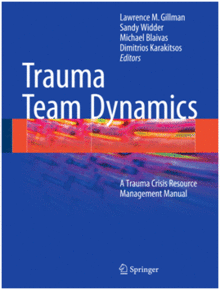
GILLMAN, L.; WIDDER, S.; BLAIVAS, M.; KARAKITSOS, D.
Descuento:
-5%Antes:
Despues:
98,79 €This is the first book exploring the unique dynamics created by a multidisciplinary trauma team and how crisis management strategies can improve teamwork and communication and, potentially, improve patient resuscitation outcomes.
Crisis resource management (CRM) is integral to the way that we manage ourselves, team members, and patients during emergency situations. It is essentially the ability to translate knowledge of what needs to be done into effective actions during a crisis situation. Building on the revolutionary American College of Surgeons Advanced Trauma Life Support (ATLS®) course, Trauma Team Dynamics illustrates the integration of the principles of CRM to team dynamics throughout the resuscitation –from the scene, through pre-hospital care and transport, to the trauma bay, and finally to definitive care and beyond.
The editors and contributors are international experts in trauma, critical care, emergency medicine, nursing, respiratory therapy, and pre-hospital care and include NASA- and United States military-affiliated experts.Trauma Team Dynamics is intended for use as both a day-to-day clinical resource and a reference text, and includes self-assessment questions as well as guidance on CRM curriculum design and implementation.
Authors
• Lawrence M. Gillman, MD MMedEd FRCSC. Department of Surgery. University of Manitoba. Winnipeg, Canada
• Sandy Widder, MD FRCSC FACS MHA MSc QIPS. Department of Surgery. University of Alberta. Edmonton, Canada
• Michael Blaivas, MD. Professor of Medicine. School of Medicine. University of South Carolina. Columbia, SC USA. Department of Emergency Medicine . St. Francis Hospital. Columbus, GA USA.
• Dimitrios Karakitsos MD PhD DSc. Department of Internal Medicine. University of South Carolina, School of Medicine. Columbia, SC USA. Division of Critical Care, Department of Anesthesiology. Keck School of Medicine. University of Southern California. Los Angeles, CA USA.
Table of contents (39 chapters)
1.The Genesis of Crew Resource Management: The NASA Experience
2.Crisis Resource Management Training in Trauma
3.Leadership Theories, Skills, and Application
4.Teamwork and Communication in Trauma
5.Situational Awareness and Human Performance in Trauma
6.Paramedical and Nonmedical Personnel
7.Transport Medicine
8.Trauma Team Structure and Organization
9.Interprofessional Trauma Team Roles
10.The Trauma Bay Environment
11.Quality Improvement and Trauma Quality Indicators
12.Putting It All Together: Quality Control in Trauma Team Training
13.Trauma Resuscitation
14.Damage Control Resuscitation
15.Damage Control: From Principles to Practice
16.Trauma Team Decision-Making
17.Emergency Critical Care Procedures
18.Trauma in the Pediatric Patient
19.Trauma in Pregnancy
20.Medical Comorbidities and Trauma
21.Basic Trauma Ultrasound
22.Trauma Ultrasound: Beyond the FAST Examination
23.Telemedicine and Future Innovations
24.Imaging in the Stable Trauma Patient
25.Disaster Medicine
26.The Multi-casualty Trauma
27.Critical Incident Team Dynamics and Logistics
28.Terrorism and Urban Trauma
29.Tactical Emergency Medicine, Procedures, and Point-of-Care Evaluation in Austere Environments
30.Trauma in Austere Environments: Cold Injuries and Hypothermia
31.War Zones and Biological Warfare
32.Nuclear Injuries
33.Trauma and Surgical Capabilities for Space Exploration
34.Designing a Simulation Curriculum
35.Designing Multidisciplinary Simulations
36.Constructive Debriefing for Trauma Team Education
37.Program Evaluation and Assessment of Learning
38.Teaching Technical and Procedural Skills
39.Multiple-Choice Review Questions
 -5%
-5%
 -5%
-5%
 -5%
-5%
 -5%
-5%
 -5%
-5%
 -5%
-5%
 -5%
-5%
 -5%
-5%
 -5%
-5%
 -5%
-5%