Descuento:
-5%Antes:
Despues:
44,45 €1. Treating the Critically Injured Military Patient
2. The Evolution of Trauma Critical Care
3. Pre Hospital treatment of the critically injured patient
4. Initial Management of the Critically Injured Patient
5. Haemodynamic Resuscitation Following Traumatic Haemorrhagic Shock- an Overview
6. Haemodynamic Optimisation of the Critically Injured Patient Blood Product and Fluid Therapy in the Critically Injured Patient
7. Management of the Patient with Trauma Induced Coagulopathy
8. Thoracic Trauma and Management of Ventilation in the Critically Injured Patient
9. Management of Blast Related Injuries
10. Managing Severe Traumatic Brain Injury outside of the Neurosciences Critical Care Unit
11. Management of the Critically Ill Patient with Burns
12. Surgical Problems in the Critically Ill Trauma Patient
13. Orthopaedic Issues in the Critical Injured Patient
14. Imaging the Critically Injured Patient
15. Management of Sedation, Analgesia and Delirium in Critically Injured Patients
16. Nutrition in the Critically Injured Patient
17. Venous thromboembolism in critically injured patients
18. Aeromedical Evacuation and Transfer of the Critically Injured Patient
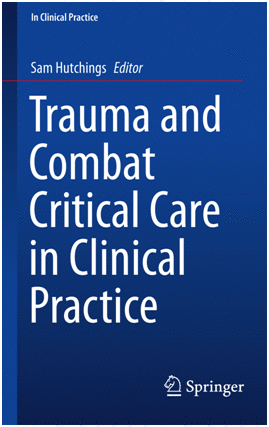
Intensive Care Medicine (or Critical Care, the terms are used interchangeably) is an evolving specialty both within the UK and worldwide. It has recently been established as a UK speciality in it’s own right, and is at the centre of the modern acute hospital, responsible for managing the sickest and most complex patients.
There is a growing cadre of critical care specialists in the UK, underpinned by a large number of doctors in training within the specialty. Management of patients with severe traumatic injury is provided by intensive care specialists, often in conjunction with a range of other professionals such as surgeons and interventional radiologists.
The management of these patients, who have competing complex injuries can be challenging. Traumatic injury is recognised as a significant cause of preventable mortality and such patients are now clustered within Major Trauma Centres across the UK.
The Defence Medical Services of the UK have spent the last 10 years managing patients with very severe traumatic injuries, first in Iraq and most recently in Afghanistan. The lessons learnt from this experience has filtered through to the NHS, resulting in many changes to established practice.
Whilst several books have been published based on this experience, none have focused on the intensive care management of such patients, which represents a vital link in the chain of survival from injury to recovery.
Features
• Makes extensive use of military authors with experience of managing complex trauma during deployed operations in Iraq and Afghanistan
• Uses flow chart diagrams as the centre of each chapter to assist readers in rapidly visualising and following a strategy for a variety of clinical problems and situations
• Contains sections within each relevant chapter on managing patients when resources are lacking
Author
Surgeon Commander Sam Hutchings is the Royal Navy’s head of specialty for Intensive Care Medicine and undertakes his clinical practice at King’s College Hospital, London. He is also a clinical academic with areas of research interest covering resuscitation endpoints in traumatic haemorrhage and the use of novel point of care perfusion assessment tools. He has deployed operationally to Iraq, Afghanistan and Sierra Leone.
 -5%
-5%
 -5%
-5%
 -5%
-5%
 -5%
-5%
 -5%
-5%
 -5%
-5%
 -5%
-5%
 -5%
-5%
 -5%
-5%
 -5%
-5%