Descuento:
-5%Antes:
Despues:
158,07 €1. Pluripotent Stem Cells and Skeletal Muscle Differentiation: Challenges and Immediate Applications
2. Role of the Ubiquitin-Proteasome Pathway in Skeletal Muscle
3. Stem Cell Therapy in Muscle Degeneration
4. The Autophagy-Dependent Signaling in Skeletal Muscle
5. Cytokines in Skeletal Muscle Growth and Decay
6. The Role of Ribosome Biogenesis in Skeletal Muscle Hypertrophy
7. Comprehensive Approach to Sarcopenia and Cachexia Treatment
8. The Role and Regulation of PGC-1a and PGC-1ß in Skeletal Muscle Adaptation
9. Characteristics of Skeletal Muscle as a Secretory Organ
10. Biological Role of TRPC1 in Myogenesis, Regeneration, and Disease
11. ROS and nNOS in the Regulation of Disuse-Induced Skeletal Muscle Atrophy
12. Participation of AMPK in the Control of Skeletal Muscle Mass
13. Therapeutic Potential of Skeletal Muscle Plasticity and Slow Muscle Programming for Muscular Dystrophy and Related Muscle Conditions
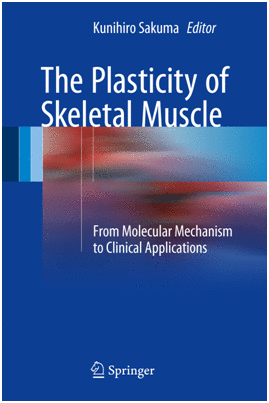
This book discusses recent advances and various topics in plasticity of skeletal muscle from the perspectives of morphology, biological function, and clinical applications. Skeletal muscle is a highly plastic organ to adapt to environmental various demands, appears to endocrine various myokines, which flow into blood to protect the recognizing function of brain and inhibit the appearance of several cancer tumorigenesis.
The book deals with current stem-cell based, pharmacological, and nutritional therapies for muscle wasting (sarcopenia, cachexia, and muscular dystrophy). It also explains the roles of biological mediators such as PGC-1, transient receptor potential cation channels (TRPC), and AMPK in modulating muscle function. The functional roles of ubiquitin-proteasome system, autophagy-dependent signaling in muscle homeostasis, ribosome biogenesis, and redox regulation of mechanotransduction to modulate skeletal muscle mass are also covered.
It is an essential resource for physicians, researchers, post-docs as well as graduate students in the field of sports science including rehabilitation therapy, exercise physiology, exercise biochemistry, and molecular biology dealing with skeletal muscle.
Features
• Discusses plasticity of skeletal muscle from the perspectives of the biochemical, biophysical, pathological, metabolic and nutritional implications
• Describes the molecular mechanism of the various adaptations of skeletal muscle and practical applications in various muscular disorders such as muscular dystrophy and sarcopenia
• A valuable professional reference source for physicians and researchers in the field of sports science
Author
Professor Kunihiro Sakuma, Ph.D., currently works at Department for Liberal Arts in Tokyo Institute of Technology. He is a Physiologist working in the field of skeletal muscle. He was awarded sports science diploma in 1995 by the University of Tsukuba and started scientific work at the Department of Physiology, Aichi Human Science Center, focusing on the molecular mechanism of congenital muscular dystrophy and normal muscle regeneration. His interest later was turned to the molecular mechanism and the attenuating strategy of sarcopenia (age-related muscle atrophy). Preventing sarcopenia is important for maintaining a high quality of life in the aged population. His opinion is to attenuate sarcopenia by improving atutophagic defect using nutrient- and pharmaceutical-based treatments.
 -5%
-5%
 -5%
-5%
 -5%
-5%
 -5%
-5%
 -5%
-5%
 -5%
-5%
 -5%
-5%
 -5%
-5%
 -5%
-5%
 -5%
-5%