Descuento:
-5%Antes:
Despues:
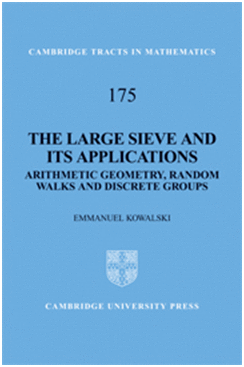
99,75 €Preface
Prerequisites and notation
1. Introduction
2. The principle of the large sieve
3. Group and conjugacy sieves
4. Elementary and classical examples
5. Degrees of representations of finite groups
6. Probabilistic sieves
7. Sieving in discrete groups
8. Sieving for Frobenius over finite fields
Appendix A. Small sieves
Appendix B. Local density computations over finite fields
Appendix C. Representation theory
Appendix D. Property (T) and Property (t)
Appendix E. Linear algebraic groups
Appendix F. Probability theory and random walks
Appendix G. Sums of multiplicative functions
Appendix H. Topology
Bibliography
Index.
Among the modern methods used to study prime numbers, the 'sieve' has been one of the most efficient. Originally conceived by Linnik in 1941, the 'large sieve' has developed extensively since the 1960s, with a recent realisation that the underlying principles were capable of applications going well beyond prime number theory. This book develops a general form of sieve inequality, and describes its varied applications, including the study of families of zeta functions of algebraic curves over finite fields; arithmetic properties of characteristic polynomials of random unimodular matrices; homological properties of random 3-manifolds; and the average number of primes dividing the denominators of rational points on elliptic curves. Also covered in detail are the tools of harmonic analysis used to implement the forms of the large sieve inequality, including the Riemann Hypothesis over finite fields, and Property (T) or Property (tau) for discrete groups.
Features
• Explores new and surprising applications of the large sieve method, an important technique of analytic number theory
• Presents applications in fields as wide ranging as topology, probability, arithmetic geometry and discrete group theory
• Motivated, clear and self-contained discussions introduce readers to a technique previously confined to one field
Author
E. Kowalski, Swiss Federal University (ETH), Zürich. Emmanuel Kowalski is Professor in the Departement Mathematik at ETH Zürich.
 -5%
-5%
 -5%
-5%
 -5%
-5%
 -5%
-5%
 -5%
-5%
 -5%
-5%
 -5%
-5%
 -5%
-5%
 -5%
-5%
 -5%
-5%
 -5%
-5%