Descuento:
-5%Antes:
Despues:
46,44 €Preface xi
Acknowledgments xv
About the Companion Website xvii
Introduction xix
Module 1 Working with and Learning About Common Laboratory Techniques and Equipment 1
Exercise 1A Using Common Laboratory Tools to Evaluate Measurements Pre-laboratory Thinking Questions 3
Exercise 1B Using Common Laboratory Tools to Evaluate Measurements 4
Exercise 1C Using Common Laboratory Tools to Evaluate Measurements Post-laboratory Thinking Questions 18
Exercise 2A Using Microscopy to Evaluate Cell Size and Complexity Pre-laboratory Thinking Questions 19
Exercise 2B Using Microscopy to Evaluate Cell Size and Complexity 20
Exercise 2C Using Microscopy to Evaluate Cell Size and Complexity Post-laboratory Thinking Questions 32
Exercise 3A The Bacterial Growth Curve Pre-laboratory Thinking Questions 35
Exercise 3B The Bacterial Growth Curve 36
Exercise 3C The Bacterial Growth Curve Post-laboratory Thinking Questions 55
Module 2 Working with and Learning About Serratia marcescens in the Laboratory 57
Exercise 4A Protein Concentration Versus Growth Stage Pre-laboratory Thinking Questions 59
Exercise 4B Protein Concentration Versus Growth Stage 60
Exercise 4C Protein Concentration Versus Growth Stage Post-laboratory Thinking Questions 69
Exercise 5A Measuring Prodigiosin Pre-laboratory Thinking Questions 71
Exercise 5B Measuring Prodigiosin 72
Exercise 5C Measuring Prodigiosin Post-laboratory Thinking Questions 84
Exercise 6A Conditions Affecting the Growth of and Prodigiosin Production by Serratia marcescens Pre-laboratory Thinking Questions 87
Exercise 6B Conditions Affecting the Growth of and Prodigiosin Production by S. marcescens 91
Exercise 6C Formal Laboratory Report Describing the Conditions Affecting the Growth of and Prodigiosin Production by S. marcescens 95
Exercise 7A Biochemistry of Prodigiosin Production Pre-laboratory Thinking Questions 101
Exercise 7B Biochemistry of Prodigiosin Production 102
Exercise 7C Biochemistry of Prodigiosin Production Post-laboratory Thinking Questions 112
Exercise 8A The Probability Basis for Mutation Rate Calculation: A Dice ]Roll Exercise Pre-laboratory Thinking Questions 113
Exercise 8B The Probability Basis for Mutation Rate Calculation: A Dice ]Roll Exercise 114
Exercise 8C The Probability Basis for Mutation Rate Calculation: A Dice ]Roll Exercise Post-laboratory Thinking Questions 120
Exercise 9A Understanding Evolution by the Generation of UV Light ]Induced Prodigiosin Mutants Pre-laboratory Thinking Questions 121
Exercise 9B Understanding Evolution by the Generation of UV Light ]Induced Prodigiosin Mutants 122
Exercise 9C Understanding Evolution by the Generation of UV Light ]Induced Prodigiosin Mutants Post-laboratory Thinking Questions 131
Exercise 10A Understanding the Energy Spilling Properties of Prodigiosin Pre-laboratory Thinking Questions 137
Exercise 10B Understanding the Energy Spilling Properties of Prodigiosin 139
Exercise 10C Understanding the Energy Spilling Properties of Prodigiosin Post-laboratory Thinking Questions 146
Module 3 Initial Characterization of Novel Serratia marcescens Prodigiosin Mutants 147
Exercise 11A Prodigiosin Mutant Study Part 1 Pre-laboratory Thinking Questions 149
Exercise 11B Prodigiosin Mutant Study Part 1 150
Exercise 11C Prodigiosin Mutant Study Part 1 Post-laboratory Thinking Questions 153
Exercise 12A Prodigiosin Mutant Study Part 2 Pre-laboratory Thinking Questions 155
Exercise 12B Prodigiosin Mutant Study Part 2 156
Exercise 12C Formal Laboratory Report 2: Prodigiosin Mutant Study 158
Appendix A CSE Citation and Reference List Format Guidelines 163
Appendix B Prodigiosin Biosynthesis 165
References 167
Index 169
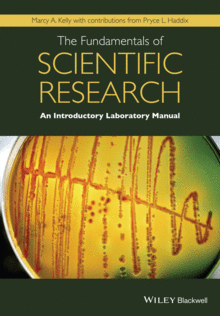
This laboratory manual is for first semester, undergraduate, science majors enrolled in a General Biology course focusing on cell biology.á The laboratory curriculum centers on studying a single organism throughout the entire semester Serratia marcescens.á S. marcescens is a Gram negative bacterium that is unique in that it produces a red pigment, prodigiosin, at high cell density.á It has been demonstrated that prodigiosin has several interesting properties; it is anti-microbial, it has shown to induce apoptosis in cancer cells, and it has been demonstrated that it has potential to act as an immunosuppressant.á There are currently many research laboratories that are attempting to enhance the production of prodigiosin because of these unique properties. The overarching goal of the laboratory course described in this manual is to have the students learn about the organism so that they can generate and initially characterize mutants of the organism that over-produce the pigment.á Mechanistically, the laboratory manual breaks down the laboratory course into two separate modules.á For the first module, the students familiarize themselves with the organism and the equipment in the laboratory by performing growth curves, Lowry protein assays, quantifying prodigiosin and ATP production, and by performing complementation studies to understand the biochemical pathway responsible for prodigiosin production. They learn how to employ Microsoft Excel to prepare and present their data in graphical format and how to use specific calculations to convert their data into meaningful numbers that can be compared across experiments.á The second module requires that the students employ UV mutagenesis to generate hyper-pigmented mutants of S. marcescens for further characterization.á They use experimental data and protocols they learned during the first module of the course to help them develop their own hypotheses, experimental protocols, and to help them analyze their data.á For each laboratory session, students are required to answer pre-laboratory questions that are designed to probe their understanding of the required pre-laboratory reading materials (which includes the experimental background and protocol for that session and, in some cases, relevant primary scientific literature related to the experiments they will be performing in the laboratory).á The questions also guide the students through the development of hypotheses and predictions. Following each laboratory, the students are required to answer a series of post-laboratory questions to guide them through the presentation of their data, analysis of their data, and placing their data into the context of the primary literature.á They are also asked to review their initial hypotheses and predictions to determine if their conclusions support their initial ascertains.á If their conclusions do not support their initial ascertains, the students are asked to provide possible explanations as to why they think their conclusions did not agree with their hypotheses. The pre-laboratory and post-laboratory questions were designed to assist the students with the preparation of the two formal laboratory reports required in the laboratory manual.á One formal laboratory report must be completed after the first module and the other, after the second module of the laboratory.á The format for the formal laboratory reports is similar to that of primary scientific literature.
 -5%
-5%
 -5%
-5%
 -5%
-5%
 -5%
-5%
 -5%
-5%
 -5%
-5%
 -5%
-5%
 -5%
-5%
 -5%
-5%
 -5%
-5%