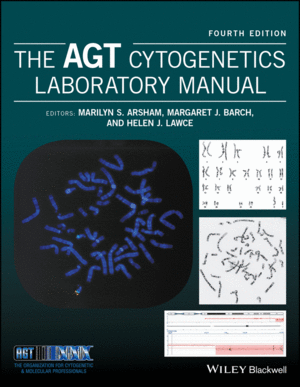
ARSHAM, M.A.; BARCH, M.J.; LAWCE, H.J.
Descuento:
-5%Antes:
Despues:
222,89 €1 The cell and cell division 1
2 Cytogenetics: an overview 25
3 Peripheral blood cytogenetic methods 87
4 General cell culture principles and fibroblast culture 119
5 Prenatal chromosome diagnosis 173
6 Chromosome stains 213
7 Human chromosomes: identification and variations 301
8 ISCN: the universal language of cytogenetics 359
9 Constitutional chromosome abnormalities 429
10 Genomic imprinting 481
11 Cytogenetic analysis of hematologic malignant diseases 499
12 Cytogenetic methods and findings in human solid tumors 577
13 Chromosome instability syndromes 653
14 Microscopy and imaging 687
15 Computer imaging 705
16 Fluorescence in situ hybridization (FISH) 717
17 Multicolor FISH (SKY and M-FISH) and CGH 833
18 Genomic microarray technologies for the cytogenetics laboratory 903
19 Mathematics for the cytogenetic technologist 937
20 Selected topics on safety, equipment maintenance, and compliance for the cytogenetics laboratory 975
21 A system approach to quality 1011
22 Laboratory management 1031
23 Laboratory information system 1045
24 Animal cytogenetics 1055
25 Online genetic resources and references 1103
Cytogenetics is the study of chromosome morphology, structure, pathology, function, and behavior. The field has evolved to embrace molecular cytogenetic changes, now termed cytogenomics.
Cytogeneticists utilize an assortment of procedures to investigate the full complement of chromosomes and/or a targeted region within a specific chromosome in metaphase or interphase. Tools include routine analysis of G-banded chromosomes, specialized stains that address specific chromosomal structures, and molecular probes, such as fluorescence in situ hybridization (FISH) and chromosome microarray analysis, which employ a variety of methods to highlight a region as small as a single, specific genetic sequence under investigation.
The AGT Cytogenetics Laboratory Manual, Fourth Edition offers a comprehensive description of the diagnostic tests offered by the clinical laboratory and explains the science behind them. One of the most valuable assets is its rich compilation of laboratory-tested protocols currently being used in leading laboratories, along with practical advice for nearly every area of interest to cytogeneticists. In addition to covering essential topics that have been the backbone of cytogenetics for over 60 years, such as the basic components of a cell, use of a microscope, human tissue processing for cytogenetic analysis (prenatal, constitutional, and neoplastic), laboratory safety, and the mechanisms behind chromosome rearrangement and aneuploidy, this edition introduces new and expanded chapters by experts in the field. Some of these new topics include a unique collection of chromosome heteromorphisms; clinical examples of genomic imprinting; an example-driven overview of chromosomal microarray; mathematics specifically geared for the cytogeneticist; usage of ISCN’s cytogenetic language to describe chromosome changes; tips for laboratory management; examples of laboratory information systems; a collection of internet and library resources; and a special chapter on animal chromosomes for the research and zoo cytogeneticist. The range of topics is thus broad yet comprehensive, offering the student a resource that teaches the procedures performed in the cytogenetics laboratory environment, and the laboratory professional with a peer-reviewed reference that explores the basis of each of these procedures. This makes it a useful resource for researchers, clinicians, and lab professionals, as well as students in a university or medical school setting.
Author Information
• Marilyn S. Arsham, (retired) Cytogenetic Technologist II, Western Connecticut Health Network, Danbury Hospital campus, Danbury, Connecticut, USA
• Margaret J. Barch, (formerly) Frank F Yen Cytogenetics Laboratory, Weisskopf Child Evaluation Center, University of Louisville, USA
• Helen J. Lawce, Clinical Cytogenetics, Oregon Health & Science University Knight Diagnostics Laboratory, USA
 -5%
-5%
 -5%
-5%
 -5%
-5%
 -5%
-5%
 -5%
-5%
 -5%
-5%
 -5%
-5%
 -5%
-5%
 -5%
-5%
 -5%
-5%