Descuento:
-5%Antes:
Despues:
453,29 €1. Introduction.
2. Key Overview Chapters.
3. One/two/three Component Regulatory Systems and stress responses.
4. Sigma Factors and stress responses.
5. Small non-coding RNA's and stress responses.
6. Toxin-Antitoxin Systems and stress responses.
7. Stringent Response to stress.
8. Responses to UV Irradiation.
9. SOS Repair Systems and stress.
10. Double Stranded Break Repair Systems and Stress.
11. Adaptation to Oxidative Stress.
12. Adaptation to Osmotic Stress.
13. Dessication tolerance and drought stress.
14. Heat Shock responses.
15. Chaperonins and stress.
16. Cold Shock Response.
17. Adaptation to Acid Stress.
18. Adaptation to Nitrosative Stress.
19. Adaptation to Cell Envelope Stress.
20. Iron Homeostasis.
21. Metal resistance.
22. Quorum Sensing.
23. Biofilm Formation.
24. Viable But Not Culturable (VBNC) Cells.
25. Climatic Changes and Stress Adaptation.
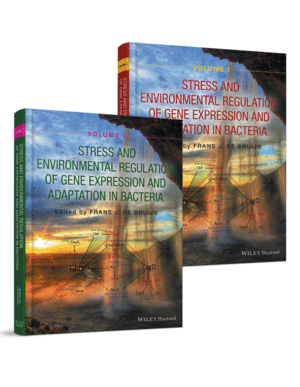
Theátopic of environmental control of gene expression and adaptation in bacteria is a very active field.á This book focuses on original research papers in a large variety of different organisms, rather than simply reviewing model systems.á The scope covers 24 different topics and provides selected new reviews as well as a series of research chapters for each topic.á Altogether it provides a detailed and broad overview of the field and emphasizes differences and commonalities in different organisms.á Most of the chapters will use molecular techniques and advanced biochemical analyses. Bacteria in various habitats are subject to continuously changing environmental conditions, such as nutrient limitation, heat and cold stress, UV radiation, oxidative stress and osmolarity fluctuations, dessication conditions, acid stress, nitrosative stresss, cell envelope stress, heavy metal exposure etc. and respond via changes in gene expression using a variety of different genetic mechanisms.á They may also adapt in other ways by forming filaments or biofilms, which often involve intercellular communication, such as quorum sensing.á The changes in gene expression are generally specific for a given stress and involve sophisticated mechanisms such as bi component regulatory circuits, alternative sigma factors, toxin-antitoxin systems, small non coding RNAs, alarmones, DNA repair, chaperones, efflux pumps and others.á In this book numerous examples of the different environmental control mechanisms in a large variety of different bacteria are presented. The first chapter will be an introduction to the book by the Editor, giving the background to the field, and its aims, describing the flow of sections and chaptersáand highlighting sections and individual contributions.á The second section will contain a number Focus Chapters (reviews) introducing the main topics of the book. The third section will cover the role of one to three component regulatory systems in theá response to changing environmental conditions.á The fourth section will address the role of alternative sigma factors under stress conditions.á The fifth section will cover the recent subfield of small non-coding RNAs in stress responses.á The sixth section will review the role of toxin-antitoxin systems in stress responses in different bacteria.á The seventh section will cover the canonical stringent response to stress in a variety of bacteria.á The eighth and ninth sections will cover UV irradiation responses in different bacteria and the canonical SOS repair system, while the tenth section will address the issue of double stranded break repair.á The eleventh and twelfth sections will discuss the response of a variety of bacteria to oxidative and osmotic stress environmental conditions, The thirteenth section will cover dessication tolerance and drought stress in bacteria.á The fourteenth,á fifteenth and sixteenth sections will address the bacterial responses to heat and cold stresses, as well as the role of Chaperones.á The seventeenth section covers the adaptation of bacteria to acid stress and the eighteenth Section the bacterial response to nitrosative stress.á The nineteenth section deals with the adaptive response to cell envelope stress.á Section twenty describes the process of iron homeostasis and twenty one the resistance mechanisms to (heavy) metals.á Bacterial quorum sensing, biofilm formation and the formation of Viable But Non_Culturable (VBNC) cells are described in Sections twenty one,á twenty two, and twenty three respectively. The final section deals with the subject of climatic changes and stress adaptation in bacteria.
 -5%
-5%
 -5%
-5%
 -5%
-5%
 -5%
-5%
 -5%
-5%
 -5%
-5%
 -5%
-5%
 -5%
-5%
 -5%
-5%
 -5%
-5%