Descuento:
-5%Antes:
Despues:
322,26 €1. Introduction
2. Elements of Physical Oceanography
3. Metocean Extreme and Operating Conditions
4. Mechanics of Ocean Waves
5. Physical Properties of Seawater
6. Principles of Marine Corrosion
7. Hydromechanics
8. Ocean Electromagnetics
9. Digital Signal Processing
10. Control Theory and Applications
11. Highly Maneuverable Biorobotic Underwater Vehicles
12. Autonomous Underwater Gliders
13. Autonomous Sea Surface Vehicles
14. Autonomous Underwater Vehicle Navigation
15. Acoustic Communication
16. Autonomous Underwater Vehicle Docking
17. Underwater Vehicle Manipulators
18. Non-Acoustic Sensors
19. Cooperative Vehicle Environmental Monitoring
20. Nested Autonomy for Distributed Ocean Sensing
21. Science of Autonomy: Time-Optimal Path Planning and Adaptive Sampling for Swarms of Ocean Vehicles
22. Cooperative Vehicle Target Tracking
23. Rules of the Road for Unmanned Marine Vehicles
24. Autonomy: Risk Assessment
25. Physical Characteristics of Coastal Hazards
26. Statistical Characterization of Hazards and Risk in Coastal Areas
27. Modeling of Coastal Waves and Hydrodynamics
28. Modeling of Coastal Morphological Processes
29. Beach Nourishment
30. Storm Hazard Mitigation Structures
31. Port and Harbor Design
32. Marine Outfalls
33. Offshore Platforms
34. Stability of Offshore Systems
35. Wave, Current and Wind Loads
36. Vortex-Induced Vibrations
37. Structural Dynamics
38. Cable Dynamics for Marine Applications
39. Offshore Geotechnics
40. Buoy Technology
41. Liquefied Natural Gas Carriers
42. Salvage Operations
43. Oil Spills and Response
44. Marine Hydrokinetic Energy Resource Assessment
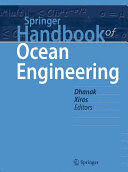
This handbook is the definitive reference for the interdisciplinary field that is ocean engineering. It integrates the coverage of fundamental and applied material and encompasses a diverse spectrum of systems, concepts and operations in the maritime environment, as well as providing a comprehensive update on contemporary, leading-edge ocean technologies. Coverage includes an overview on the fundamentals of ocean science, ocean signals and instrumentation, coastal structures, developments in ocean energy technologies and ocean vehicles and automation. It aims at practitioners in a range of offshore industries and naval establishments as well as academic researchers and graduate students in ocean, coastal, offshore and marine engineering and naval architecture.
The Springer Handbook of Ocean Engineering is organized in five parts: Part A: Fundamentals, Part B: Autonomous Ocean Vehicles, Subsystems and Control, Part C: Coastal Design, Part D: Offshore Technologies, Part E: Energy Conversion
Features
• Provides a comprehensive well-written account of research and development in ocean/marine engineering, naval architecture and related disciplines by leading experts in the field
• Discusses the latest in ocean engineering research, including harnessing the ocean as an energy resource, coastal protection techniques and offshore and subsea engineering automation
• Covers a wide spectrum of ocean engineering with material anchored in seven parts in over forty-five chapters
Authors
• Dr. Dhanak is the Director of The Institute for Ocean and Systems Engineering (SeaTech) and Professor of Ocean Engineering at Florida Atlantic University. He also serves as Director of Research for Southeast National Marine Renewable Energy Center and is the past Chairman of the Department of Ocean Engineering.
• Dr. Xiros is a Professor of Ocean Engineering at the University of New Orleans and his research interests include marine engineering and control systems for renewable energy.
 -5%
-5%
 -5%
-5%
 -5%
-5%
 -5%
-5%
 -5%
-5%
 -5%
-5%
 -5%
-5%
 -5%
-5%
 -5%
-5%
 -5%
-5%