Descuento:
-5%Antes:
Despues:
85,95 €1. Diagnosis and Control for Multi-agent Systems Using Immune Networks
2. Universality and Complexity of Approximation of Multivariable Functions by Feedforward Networks
3. The Supervised Learning No-Free-Lunch Theorems
4. Making Evolutionary Design Optimisation Popular in Industry: Issues and Techniques
5. Theory of Incursive Synchronization and Anticipatory Computing of Chaos
6. Computing with Autopoietic Systems
7. The Internet and Education: Forces at War?
8. Soft Computing for Control of Dynamical Systems
9. Holonic Scheduling for an Assembly Line
10. Combining First Principles Models and Neural Networks for Generic Model Control
11. Adaptive Model-Based Control of Non-Linear Plants using Neural Networks and Fuzzy Logic
12. Intelligent Control of a Battery Charging Process with a Hybrid Approach
13. A Breeder Genetic Algorithm for Adaptive Filter Optimization
14. Intelligent Control of Robotic Autonomous Systems using a Neuro-Fuzzy-Genetic Approach
15. Prediction of Power Requirement in Turning using a GA-Fuzzy Approach
16. Predictive Control of a Nonlinear Process Using Multiple Models Optimization Based on Fast Evolutionary Programming
17. Some Realisation Issues of Fuzzy Gain-Scheduling Controllers: a Robotic Manipulator Case Study
18. Environmental Safety and Loss Prevention in Sulphur Tank with Fuzzy L
19. Autotuning of a Fuzzy PID Controller Based on Fuzzy Gain and Phase Margins: Analysis and Design
20. Two Automatic On-line New Schemes to Compensate the Torque Ripple of Switched Reluctance Machines: With and Without Torque Signal Measurement
21. Applications of Neural Networks in Servo Systems - A Survey
22. Some Methods of Clustering of Fuzzy Objects
23. Integration of Enhanced Adaptive Fuzzy Clustering Algorithm with Probabilistic Technique for Dynamic Map Building
24. Classification of Severe Storm Cells Using Support Vector Machines
25. Fuzzy Clustering for the Identification of Compact Fuzzy Classifiers
26. Multi-Constrained Nonlinear Optimization by the Differential Evolution Algorithm
27. Genetic Algorithms for the Assembly Line Balancing Problem: A Real-World Automotive Application
28. A Genetic Algorithm for the Uncapacitated Network Design Problem
29. An Overview of Benchmarking Techniques for Multi-Objective Evolutionary Algorithms
30. Fuzzy Cluster Loading for 3-way Data
31. A Robust Multilevel Watermarking Method for Digital Images using Multiresolution Wavelet Decomposition
32. Fuzzy Relational Pattern Dynamics of the Breast Cancer Cells
33. Slope Constrained Shortest Path on Surface: A Stochastic Approach
34. Design of Explicitly or Implicitly Parallel Low-resolution Character Recognition Algorithms by Means of Genetic Programming
35. Low-Power Massively Parallel Feature Computation for Application-Specific Integrated Vision Systems
36. Pulse Image Processing
37. Soft Data Fusion in Image Processing
38. Eigenspace-based Face Recognition
39. Dimensionality Reduction and Interactive Visualization of Multivariate Data — Methods, Tools, Applications
40. Developing Agent-Based Personalized Recommender Systems: An Experimental Study
41. An Agent That Learns to Support Users of a Website
42. ANTS: Automatic Navigation of Terrain Systems
43. Greta: A Simple Facial Animation Engine
44. Fast Text Compression Using Artificial Neural Networks
45. Visualization of Data Using Genetic Algorithm
46. Measuring Facial Emotional Expressions Using Genetic Programming
47. Fuzzy Based Web Server Workload Modeling and Prediction
48. Efficient and Precise Handling of a Piecewise-Linear Fuzzy Set on Computers in an Extended Knot Form
49. Kansei Factor Analysis Using C4.5
50. An Active Search Algorithm Extending GA Based Path Planning for Mobile Robot Systems
51. Genetic Programming for Combining Neural Networks for Drug Discovery
52. Training MLP Networks by the Differential Evolution Algorithm
53. A Genetic Algorithm Based on Cell Loss for Dynamic Routing in ATM Networks
54. Gene Expression Programming in Problem Solving
55. Studies of the XCSI Classifier System on a Data Mining Problem
56. Artificial chemistry - a new metaphor for evolutionary algorithms
57. Immune System Simulation through a Complex Adaptive System Model
58. The Effectiveness of Mutations: Simulation of Natural Mechanisms
59. Root-Finding of Monotone Nonlinear Functions with Fuzzy Iterative Methods
60. On Partitioned Fitness-Distributions of Genetic Operators for Predicting GA Performance
61. A Comparative Assessment on the Application of Knowledge-based Networks and Genetic Algorithms to the Design of Fuzzy Diagnosis Systems for Rotating Machinery
62. Evolution of a Tactile Wall-Following Behavior in Real Time
63. Fuzzy-Memetic Approach for Prediction of Chaotic Time Series and Nonlinear Identification
64. Finite-Element Mesh Adaptation via Time Series Prediction Using Neural Networks
65. Multi-Objective Genetic Algorithms on Financial Ratio Selection for Earning Forecast
66. Hybrid Genetic Algorithm for VLSI Macro Cell Layout
67. Artificial Neural Networks Modeling as an Industrial Plant Fault Diagnostic Tool
68. An Application of Genetic Programming to Electronic Design Automation: from Frequency Specifications to VHDL Code
69. A Comparision of Soft Computing Methods for Reservoir Simulation
70. Multistage Decision Making for a Fuzzy Automaton by Simulated Annealing
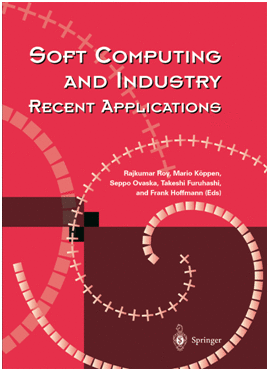
Soft computing embraces various methodologies for the development of intelligent systems that have been successfully applied to a large number of real-world problems. Soft Computing in Industry contains a collection of papers that were presented at the 6th On-line World Conference on Soft Computing in Industrial Applications that was held in September 2001. It provides a comprehensive overview of recent theoretical developments in soft computing as well as of successful industrial applications. It is divided into seven parts covering material on:
keynote papers on various subjects ranging from computing with autopoietic systems to the effects of the Internet on education; intelligent control; classification, clustering and optimization; image and signal processing; agents, multimedia and Internet; theoretical advances; prediction, design and diagnosis. The book is aimed at researchers and professional engineers who develop and apply intelligent systems in computer engineering.
 -5%
-5%
 -5%
-5%
 -5%
-5%
 -5%
-5%
 -5%
-5%
 -5%
-5%
 -5%
-5%
 -5%
-5%
 -5%
-5%
 -5%
-5%