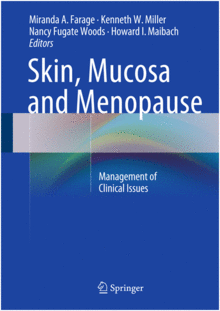
FARAGE, M.; MILLER, K.W.; FUGATE W.; MAIBACH, H.
Descuento:
-5%Antes:
Despues:
148,19 €- Detailed review of the direct and indirect dermatological effects of the menopause
- Evaluation of treatment effectiveness
- Holistic view of the menopause as a life transition rather than as a series of distinct medical conditions
An era of global population aging is upon us. By 2030, one in eight people will be over age 65. Since women generally live longer than men, the health and welfare of postmenopausal women will become a significant public health concern. This book offers a comprehensive review of the life changes associated with menopause, both at the dermatological and physiological level (e.g., hormonal, immunological) and at the subcellular level. It critically examines the dermatological, biological, and clinical challenges to postmenopausal health and well-being and the current and emerging therapeutic interventions. The authors advocate a holistic approach, emphasizing the need to view the menopause as a life transition with various facets rather than as a series of distinct medical conditions to be managed. Our goal is to offer a comprehensive resource to the researchers, clinicians, physicians, and helping professions whose mission is to promote the health and well-being of women around the world.
Authors
- Miranda A. Farage is a Research Fellow in the Clinical Sciences Innovation at The Procter and Gamble Company, Cincinnati, Ohio. Dr. Farage leads research on genital health, dermatological testing and claims, methods development, sensitive skin, physiology, toxicology, women’s health, quality of life, and related fields. She is the author of more than 190 manuscripts in peer-reviewed journals. She is also the co-editor of several books and has co-authored medical textbooks on women’s health, aging skin and consumers, cosmeceutical sciences, and dermatotoxicology. Dr. Farage is on the editorial board of several scientific journals. Dr. Farage received a PhD in Medical Sciences from the University of Illinois, Urbana-Champaign.
- Kenneth W. Miller is the Associate Director for Global Product Stewardship in the Feminine Care business unit at The Procter and Gamble Company. Dr. Miller is responsible for the strategic development and execution of research and testing in the areas of dermatotoxicology, clinical safety and efficacy studies, post-market surveillance studies, epidemiology studies, environmental studies (biodegradation, solid waste disposal, aquatic and terrestrial toxicology, and global waste disposal infrastructure), standard microbiological testing, and microbiological methods development research (including molecular microbiology techniques). He also has responsibility for a team conducting microbiological and clinical research in toxic shock syndrome, superantigens, and vaginal microbial ecology. Dr. Miller has published over fifty manuscripts in the area of toxicology in peer-reviewed journals plus numerous abstracts, book chapters, and presentations at meetings of scientific societies. Dr. Miller is a member of several scientific and professional societies.
- Nancy Fugate Woods, PhD, RN, FAAN, is Professor and Dean Emeritus at the University of Washington School of Nursing. Dr. Woods has led a sustained program of research in the field of women’s health. Her collaborative, interdisciplinary research has resulted in an improved understanding of women’s experiences of menstrual cycle symptoms as well as the menopausal transition, including endocrine, social, personal, and genetic factors influencing symptoms and women’s approaches to symptom management. In 1989, Dr. Woods and her colleagues, including Dr. Joan Shaver, established the first NIH-funded Center for Women’s Health Research at the University of Washington School of Nursing and established the Seattle Midlife Women’s Health Study, a longitudinal study of women during the menopausal transition and early postmenopause. Dr. Woods is an investigator for the Women’s Health Initiative Study and for the MsFLASH study of symptom management approaches for hot flashes and related symptoms. Her honors include election to the Institute of Medicine of the National Academies and to the American Academy of Nursing.
- Howard I. Maibach is Professor of Dermatology at the University of California at San Francisco School of Medicine. He is the author of over 1700 papers in dermatology, toxicology, pharmacology, physiology, and related fields and the co-editor of several books, including Cosmeceuticals,Cutaneous Infection and Therapy, Cutaneous Infestations and Insect Bites, Neonatal Skin,Percutaneous Absorption, 3rd edition, and Psoriasis, 3rd edition. Dr. Maibach received his MD from Tulane University.
Table of contents (34 chapters)
1.What Is Menopause? An Overview of Physiological Changes
2.Skin and Menopause
3.Skin Changes in Menopause
4.Menopause and Oxidative Stress
5.The Effect of Cytokines on Skin During Menopause
6.The Role of Estrogen Deficiency in Skin Aging and Wound Healing
7.Skin and Effect of Hormones and Menopause
8.Effects of Hormone Replacement Therapy on Skin Viscoelasticity During Climacteric Aging
9.Frontal Fibrosing Alopecia
10.Female-Specific Pruritus from Childhood to Postmenopause: Clinical Features, Hormonal Factors, and Treatment Considerations
11.Gender Differences in Production and Circulating Levels of Sex Hormones and Their Impact on Aging Skin
12.Hair Changes Caused by Aging
13.Changes in Nails Caused by Aging
14.Atrophic Vaginitis in the Menopause
15.Sensory Perception on the Vulva and Extragenital Sites
16.Gynaecological Problems Associated with Menopause
17.Changes to Skin with Aging and the Effects of Menopause and Incontinence
18.Current and Emerging Treatment Options for Vulvovaginal Atrophy
19.Implications of the Vulvar Sensitive Skin Syndrome After Menopause
20.Vulval Disease in Postmenopausal Women
21.Vulvodynia in Menopause
22.Dermatologic Conditions of the Vulva During Menopause
23.The Effects of Menopause on Autoimmune Diseases
24.Genes, Hormones, Immunosenescence, and Environmental Agents: Toward an Integrated View of the Genesis of Autoimmune Disease
25.Menopause and Aging Skin in the Elderly
26.Autoimmune Skin Diseases: Role of Sex Hormones, Vitamin D, and Menopause
27.Postmenopausal Vulva and Vagina
28.Physical Activity and Quality of Life During Menopausal Transition and Postmenopause
29.Quality of Life
30.Vasomotor Symptoms
31.The Menopausal Transition and Women’s Health
32.Menopause and Cosmeceuticals
33.Cosmetic Procedures in Menopause
34.Menopause: Cross-Cultural Considerations
 -5%
-5%
 -5%
-5%
 -5%
-5%
 -5%
-5%
 -5%
-5%
 -5%
-5%
 -5%
-5%
 -5%
-5%
 -5%
-5%
 -5%
-5%