Descuento:
-5%Antes:
Despues:
118,55 €1. Minimally invasive access to the prostate--The concept of surgical space creation
2. Surgeon's Notebook: Beyond the Learning Curve: The Original Handouts from the American Urological Association Post-graduate Courses 2013-2015
3. The Dorsal Vein Complex--Achieving Hemostasis and Proper Set-up for Apical Division
4. The Simple Bladder Neck
5. Bladder Neck--Anatomic Variants, Prior TUR, Locally Advanced Tumors
6. Neurovascular Bundle Preservation: Anatomic and Technical Considerations
7. Partial Neurovascular Bundle Sparing during Robot-Assisted Radical Prostatectomy
8. Neurovascular Structure-adjacent Frozen-section Examination (NeuroSAFE) in robot-assisted radical prostatectomy
9. Neurovascular Bundle - Wide Excision
10. Apex--The Crossroads of Functional Recovery and Oncologic Control
11. Post-Resection: Hemostasis, Checking for Rectal Injury, Anastomotic Leaks
12. Denonvilliers Fascia--Anatomy, Surgical Planes, Use in Reconstruction
13. Vesico-urethral Anastomosis--Putting it Back Together
14. Pelvic Lymph Node Dissection--Open Benchmarks with Lymphoscintigraphy
15. Pelvic Lymph Node Dissection--Robotic Surgery Efficiency and Space-Creation Techniques to Achieve an Extended Template
16. Innovation and Orientation Challenges--Posterior 'Retzius Sparing' Technique
17. Getting Out--Closure, Prevention and Management of Hernias
18. Robot-Assisted Radical Prostatectomy Extraperitoneal and Transperitoneal Techniques
19. Perioperative Medical Evaluation of the Patient undergoing RARP
20. Patient Positioning and Safety in Steep Trendelenburg
21. Safety checklist for training and assessment in robot assisted prostate surgery
22. Immediate Post-Operative Care Following Robot Assisted Radical Prostatectomy
23. Penile Rehabilitation: Recovering Erectile Function following Prostate Cancer Treatment
24. Structured Reporting of RARP Complications--Are We Making Measurable Progress?
25. Quality of Life Evaluation: What is Published and Practical for Routine Use
26. Positive Surgical Margins: How to Self-Evaluate and Improve
27. High Risk Pathology: State-of-the-Art Post-Operative Radiation Recommendations and Integration of Novel Genomic Risk
28. Biomarkers
29. Long-term Oncologic Outcomes
30. Personalized versus Generic Patient Handouts--Tools to Improve Patient Knowledge on Treatment Options and Peri-operative Care
31. Active Surveillance and Patient Support Intervention
32. A Return to Key Surgical Technique: Neurovascular Bundle Sparing with Antegrade Technique
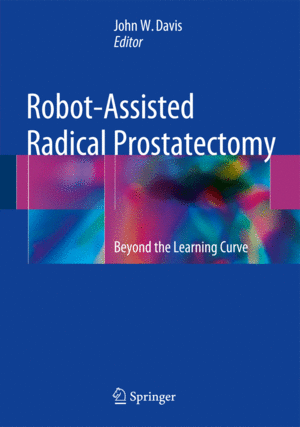
This book addresses knowledge gaps in RARP in 3 key sections: 1) Step-by-step approach including multiple technique options and innovations, 2) Patient selection, safety, outcomes, and 3) Preparing the patient for surgery. The order is more based upon knowledge priority rather than a chronologic sequence in which part 3 would go first. Part two allows more summary and commentary on evidence and part three allows some creative content that is otherwise hard to find in one place—medical evaluations, imaging, clinical trials, patient education, etc. This textbook emphasizes content for the advanced skills surgeon in that multiple techniques are presented as well as state of the art evidence. The learning curve is addressed and the authors clarify how this text is useful for learners. The caveat is that they should be careful in patient selection and stick with what their mentors are showing them. With experience, they can then branch out into the many techniques presented here. Robot-Assisted Radical Prostatectomy: Beyond the Learning Curvewill also have cross-over appeal for surgical assistants, physician assistants, nurses, and anyone else involved in the surgical care of prostate cancer.
Features
• Provides a step-by-step approach including multiple technique options and innovations
• Richly illustrated with color photographs, illustrations and figures.
• Written by experts in the field
Author
John W. Davis, MD, FACS
Associate Professor, Department of Urology, Division of Surgery, The University of Texas MD Anderson Cancer Center, Houston, TXDirector, Urosurgical Prostate Program, Department of Urology, The University of Texas MD Anderson Cancer Center, Houston, TX Education & Training. Degree-Granting Education 1994 University of Virginia School of Medicine, Charlottesville, VA, MD, Medicine1990 Davidson College, Davidson, NC, BS, BiologyPostgraduate Training 7/2002-12/2003 Clinical Fellowship, Laparoscopic Urology, Charite Hospital, Berlin, Germany, Dr. Stefan Loening7/2001-6/2002 Clinical Fellowship, Urologic Oncology, The University of Texas MD Anderson Cancer Center, Houston, TX, Dr. David Swanson7/1999-6/2001 Clinical Fellowship, Postdoctoral Fellow, Microbiology, Eastern Virginia Medical School, Norfolk, VA, Dr. George Wright, Ph. D.7/1996-6/1999 Clinical Residency, Urology, Eastern Virginia Medical School, Norfolk, VA, Dr. Paul Schellhammer7/1994-6/1996 Clinical Internship, PGY-2 General Surgery, Eastern Virginia Medical School, Norfolk, VA, Dr. L. D. Britt
 -5%
-5%
 -5%
-5%
 -5%
-5%
 -5%
-5%
 -5%
-5%
 -5%
-5%
 -5%
-5%
 -5%
-5%
 -5%
-5%
 -5%
-5%