Descuento:
-5%Antes:
Despues:
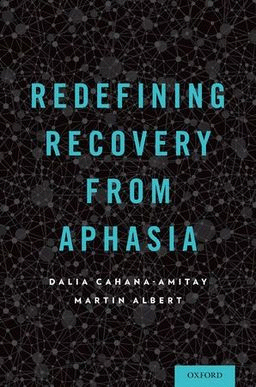
76,08 €- Explains how the brain creates language.
- Offers new approaches to aphasia therapy.
- Redefines the concept of recovery from aphasia.
This book focuses on two fundamental aspects of brain-language relations: one concerns the neural organization of language in the healthy brain; the other challenges current approaches to treatment of aphasia and offers a new theory for recovery from aphasia. The essence of the book lies in the phrase neural multifunctionality: the constant and dynamic incorporation of non-linguistic functions into language models of the intact brain. The book makes the claim that language is a construction, created as we use it, and cannot be understood as being supported by neurally based linguistic networks only. Rather, language emerges from the constant and dynamic interaction among neural networks subserving cognitive, affective, and praxic functions with neural networks subserving lexical retrieval (naming), sentence processing (comprehension), and discourse (communication, conversation). In persons with stroke-induced aphasia, neural networks for executive system function, attention, memory, motor system function, visual system function, and emotion interact with neural networks for language to produce the aphasia profile and to influence recovery from aphasia. Consequently, neural multifunctionality in aphasia explains individual differences in the lesion-deficit model and continued recovery over time, redefining the concept of recovery from aphasia and offering new opportunities for treatment.
Readership: Cognitive neuroscientists Cognitive scientists Behavioral neurologists General neurologists Neuropsychiatrists Neuroimaging specialists Speech pathologists Linguists Psycholinguists Neurolinguists Aphasiologists Psychologists Neuropsychologists Specialists in neurological rehabilitation Masters level and doctoral level students in each of these specialties.
Author Information
Dalia Cahana-Amitay, PhD, Boston University, and Martin Albert, MD, PhD, Boston University
Dalia Cahana-Amitay, PhD Research Assistant Professor Of Neurology Associate Director, Harold Goodglass Aphasia Research Center And Language In The Aging Brain Boston University School Of Medicine Va Boston Healthcare System Boston, MA
Martin Albert, MD, PhD Professor Of Neurology Director, Harold Goodglass Aphasia Research Center Boston University School Of Medicine Va Boston Healthcare System Boston, MA.
Table of Contents
1: What we know and do not know about recovery from aphasia
2: Language in the healthy brain: evidence for multifunctionality
3: Executive functions and aphasia recovery
4: Attention systems and aphasia recovery
5: The role of memory functions in aphasia recovery
6: The role of emotion in recovery from aphasia
7: Praxis in aphasia recovery
8: Visual processing in aphasia recovery
9: Redefining recovery from aphasia
 -5%
-5%
 -5%
-5%
 -5%
-5%
 -5%
-5%
 -5%
-5%
 -5%
-5%
 -5%
-5%
 -5%
-5%
 -5%
-5%
 -5%
-5%