Descuento:
-5%Antes:
Despues:
118,55 €1. History of Rapid Prototyping
2. Creation of a 3D Printed Model: From Virtual to Physical
3. Image Acquisition for Creation of a 3D Model: CT, CMR, and Echocardiography
4. Postprocessing: Software and Technique Options
5. Rapid Prototyping Technologies
6. Imaging Considerations and Challenges in Pediatrics
7. Septal Defects
8. Tetralogy of Fallot with Major Aortopulmonary Collateral Arteries
9. Double Outlet Right Ventricle
10. Pulmonary Valve Placement
11. Adult Congenital Heart Disease
12. Transcatheter Aortic Valve Replacement
13. Valvular Heart Disease
14. Assessment of Ventricular Assist Device Placement and Function
15. Cardiac Tumors
16. Establishing a Cardiovascular Rapid Prototyping Service
17. Utility of a 3D File Database
18. 3D Bioprinting for Cardiovascular Tissue Engineering
19. Past Developments and Future Directions of 3D Cardiac Printing: A Surgeon’s Perspective
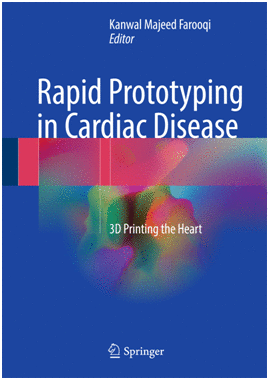
This book provides an overview of the use of rapid prototyping in patients with cardiac pathology. With the exponential increase in the use of prototyping, or 3D printing technology, medical applications are becoming more widespread across specialties. Although medical centers are beginning to apply this technology for improved patient care, there is no single text to which specialists can refer for guidance about this emerging modality. The book discusses the use of rapid prototyping in medicine; model creation; image acquisition; rapid prototyping techniques; applications in congenital and structural heart disease; and development and management of a rapid prototyping service. The use of rapid prototyping for pre-procedural planning in patients with cardiac disorders such as septal defects, Tetralogy of Fallot, transcatheter aortic valve replacement, and ventricular assist devices and heart transplant significantly enhances visualization of cardiovascular anatomy. Rapid Prototyping in Cardiac Disease is a unique and valuable resource for cardiac imaging specialists, cardiothoracic surgeons, radiologists, and biomedical engineers.
Features
• Provides an overview of the use of rapid prototyping in patients with cardiac pathology
• Discusses use of rapid prototyping in medicine, image acquisition, rapid prototyping techniques, applications in congenital and structural heart disease, and development of a rapid prototyping service
• Enhances pre-procedural planning in patients with cardiac disorders by enhancing visualization of cardiovascular anatomy
Author
Kanwal Majeed Farooqi, MD, Assistant Professor of Pediatrics, Division of Pediatric Cardiology, Rutgers, New Jersey Medical School, Newark, NJ, USA, Adjunct Assistant Professor of Pediatrics, Division of Pediatric Cardiology, Icahn School of Medicine at Mount Sinai, New York, NY, USA
 -5%
-5%
 -5%
-5%
 -5%
-5%
 -5%
-5%
 -5%
-5%
 -5%
-5%
 -5%
-5%
 -5%
-5%
 -5%
-5%
 -5%
-5%