Descuento:
-5%Antes:
Despues:
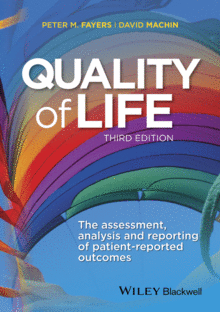
103,74 €The assessment of patient reported outcomes and health-related quality of life continue to be rapidly evolving areas of research and this new edition reflects the development within the field from an emerging subject to one that is an essential part of the assessment of clinical trials and other clinical studies.
This book is aimed at everyone involved in quality-of-life research and is applicable to medical and non-medical, statistical and non-statistical readers. It is of particular relevance for clinical and biomedical researchers within both the pharmaceutical industry and clinical practice.
The analysis and interpretation of quality-of-life assessments relies on a variety of psychometric and statistical methods which are explained in this book in a non-technical way. The result is a practical guide that covers a wide range of methods and emphasizes the use of simple techniques that are illustrated with numerous examples, with extensive chapters covering qualitative and quantitative methods and the impact of guidelines. The material in this new third edition reflects current teaching methods and content widened to address continuing developments in item response theory, computer adaptive testing, analyses with missing data, analysis of ordinal data, systematic reviews and meta-analysis.
Table of Contents
• PART 1 Developing and Validating Instruments for Assessing Quality of Life and Patient-Reported Outcomes
1 Introduction 3
2 Principles of measurement scales 35
3 Developing a questionnaire 57
4 Scores and measurements: validity, reliability, sensitivity 89
5 Multi ]item scales 125
6 Factor analysis and structural equation modelling 149
7 Item response theory and differential item functioning 189
8 Item banks, item linking and computer-adaptive tests 223
• PART 2 Assessing, Analysing and Reporting Patient-Reported Outcomes and the Quality of Life of Patients
9 Choosing and scoring questionnaires 243
10 Clinical trials 259
11 Sample sizes 283
12 Cross ]sectional analysis 309
13 Exploring longitudinal data 345
14 Modelling longitudinal data 367
15 Missing data 393
16 Practical and reporting issues 429
17 Death, and quality-adjusted survival 447
18 Clinical interpretation 475
19 Biased reporting and response shift 511
20 Meta ]analysis 527
Appendix 1: Examples of instruments 547
Appendix 2: Statistical tables 579
Index 613
 -5%
-5%
 -5%
-5%
 -5%
-5%
 -5%
-5%
 -5%
-5%
 -5%
-5%
 -5%
-5%
 -5%
-5%
 -5%
-5%
 -5%
-5%