Descuento:
-5%Antes:
Despues:
211,43 €1. Approach to Visual Acuity Assessment and Strabismus Evaluation of the Pediatric Patient
2. Sensorial Adaptations to Strabismus
3. Management of Asymptomatic Hypermetropia in Infancy and Early Childhood
4. Myopia
5. Management of Astigmatism in Children
6. Pediatric Contact Lenses for Medical Indications
7. Pediatric Refractive Surgery
8. Practical Management of Amblyopia
9. Diagnosis and Management of Conjunctivitis in Infancy and Childhood
10. Diagnosis and Management of Corneal Ulcers in Pediatric Patients
11. Pediatric Herpes Virus Anterior Segment Infections
12. The Anesthetic Cornea and Exposure Keratopathy in Infants and Children
13. Peters Anomaly
14. Anterior Segment Dysgenesis Syndromes
15. Management of the Patient with Hyphema
16. Management of Chemical Ocular Injuries in Pediatric Patients
17. Anterior Segment Trauma (Non-chemical)
18. Cataracts
19. Management of Infantile and Childhood Cataracts
20. Persistence of the Fetal Vasculature: Varieties and Management
21. Evaluation and Management of the Patient with Subluxated Lenses
22. Uveitis Associated with Juvenile Idiopathic Arthritis
23. Noninfectious Intermediate and Posterior Uveitis
24. Infectious Uveitis
25. Pediatric Masquerade Uveitis
26. Retinal Imaging for Pediatric Patients
27. Use of Optical Coherence Tomography in the Eyes of Children
28. Electroretinography in Pediatric Retinal Dystrophies
29. Retinopathy of Prematurity
30. Management of Pediatric Posterior Segment Trauma in Children
31. Non-accidental Trauma: Abusive Head Trauma
32. Screening for Vigabatrin (Sabril®) Retinal Toxicity in Children
33. Genetic Counseling and Testing
34. Retinal Dystrophies: Clinical Work-Up and Selected Examples
35. Inherited Vascular Disorders
36. The Phakomatoses
37. Retinoblastoma
38. Optic Nerve Malformations
39. Evaluation and Management of Optic Pathway Gliomas
40. Pediatric Pseudotumor Cerebri Syndrome
41. Optic Neuritis in Children
42. Childhood Glaucoma
43. Aphakic/Pseudophakic Glaucoma
44. Diagnosis and Management of Juvenile Open-Angle Glaucoma
45. Diagnosis and Management of Infantile Esotropia
46. Diagnostic Challenges in Acquired Non-accommodative Esotropia
47. Management of Accommodative Esotropia
48. Sixth Nerve Palsy in Children
49. Diagnosis and Management of Fourth Nerve Palsy in Children
50. Cranial Nerve III Palsy in Children
51. Management of Exotropia in Childhood
52. Duane Retraction Syndrome
53. Management of Strabismus in Thyroid Eye Disease
54. A- and V-Pattern Strabismus
55. Congenital Cranial Dysinnervation Disorders
56. Differential Diagnosis and Management of Hyperdeviations: Non-4th Nerve Palsy—Dissociated Vertical Deviations and Skew Deviations
57. Approaches to Strabismus Reoperation
58. Brown Syndrome
59. Acute Strabismus
60. Complications of Strabismus Surgery
61. Nasolacrimal Duct Obstruction
62. Management of Blepharoptosis in Infancy and Childhood
63. Preseptal and Orbital Cellulitis
64. Current Management of Inferior Orbital Wall Fractures in Children
65. Noninfectious Causes of Proptosis in Children
66. Craniosynostosis and Congenital Craniofacial Disorders
67. Supplement: Special Considerations in the Management of Amblyopia and Strabismus in Craniofacial Disorders
68. Management of Vision Impairment in Children
69. Down Syndrome
70. Nystagmus in Pediatric Age Group: Clinical Features and Management
71. Nonorganic Vision Loss in Children
72. Basic Retinoscopy
73. Dynamic Retinoscopy
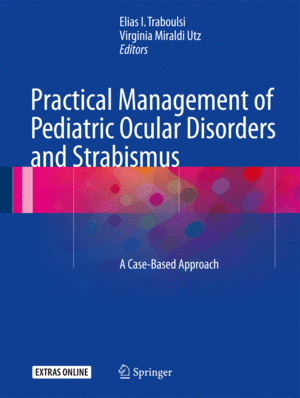
This case-based approach to the management of pediatric eye diseases and strabismus teaches the novice, as well as the experienced surgeon, how to conceptualize and analyze surgical planning to maximize patient outcomes, allowing readers to “get inside the head of the surgeon.” Individual cases with clear instructions and an abundance of color illustrations, presented by experts in the field, teach critical information one case at a time.
Practical Management of Pediatric Ocular Disorders and Strabismus provides the key guiding principles of a traditional textbook in an easy-to-digest format. Each chapter of the text tackles a common or rare clinical situation and begins with the description of an illustrative case. The chapters are structured with sections on case description, differential diagnosis, management and outcomes with a list of possible complications and the approach to their management.
Features
• Case-based approach to the management of pediatric eye diseases and strabismus
• Teaches the novice, as well as the experienced surgeon, how to conceptualize and analyze surgical planning to maximize patient outcomes
• Allows readers to “get inside the head of the surgeon”
• Individual cases with clear instructions and an abundance of color illustrations
• Written by experts in the field
• Teaches critical information one case at a time
• Provides the key guiding principles of a traditional textbook in an easy-to-digest format
• Each chapter tackles a common or rare clinical situation and begins with the description of an illustrative case
• Chapters structured with sections on case description, differential diagnosis, management and outcomes with a list of possible complications and the approach to their management
Authors
• Elias I. Traboulsi, M.D., M.EdProfessor of OphthalmologyCleveland ClinicCole Eye InstituteCleveland, Ohio
• Virginia Miraldi Utz, MDAssistant Professor of Pediatric Ophthalmology and Adult StrabismusCincinnati Children’s Hospital Medical CenterAbrahamson Pediatric Eye InstituteCincinnati, Ohio
Assistant Editor:
• Michelle M. Arris, MDAssistant Professor of OphthalmologyChildren’s Mercy Hospitals & ClinicsDepartment of Ophthalmology Kansas City, Missouri
 -5%
-5%
 -5%
-5%
 -5%
-5%
 -5%
-5%
 -5%
-5%
 -5%
-5%
 -5%
-5%
 -5%
-5%
 -5%
-5%
 -5%
-5%