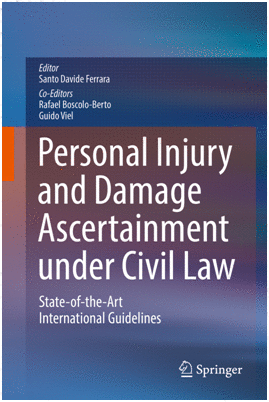
FERRARA, S.D.; BOSCOLO-BERTO, R.; VIEL, G.
Descuento:
-5%Antes:
Despues:
113,62 €1. Bio-Medicolegal Sciences and Personal Injury/Damage Ascertainment in the Post-Genomic Era
2. The Holistic and Systematic Approach in Legal Medicine
3. Causal Value and Causal Link
4. Compensation for Personal Injury in a Comparative Perspective: The Need to Bridge Legal and Medicolegal Knowledge
5. Methods of Ascertainment of Personal Damage in Portugal
6. Methods of Ascertainment of Personal Damage in Spain
7. Methods of Ascertainment of Personal Damage in France
8. Methods of Ascertainment of Personal Damage in Italy
9. Methods of Ascertainment of Personal Damage in Belgium
10. Methods of Ascertainment of Personal Damage in the Netherlands
11. Methods of Ascertainment of Personal Damage in the United Kingdom
12. Methods of Ascertainment of Personal Damage in Germany
13. Methods of Ascertainment of Personal Damage in Hungary
14. Methods of Ascertainment of Personal Damage in Lithuania
15. Methods of Ascertainment of Personal Damage in Estonia
16. Methods of Ascertainment of Personal Damage in the USA
17. Methods of Ascertainment of Dental Damage in Argentina
18. Methods of Ascertainment of Personal Damage in Egypt
19. Methods of Ascertainment of Personal Damage in Nigeria
20. Methods of Ascertainment of Personal Damage in Turkey
21. Methods of Ascertainment of Personal Damage in the Kingdom of Saudi Arabia
22. Methods of Ascertainment of Personal Damage in India
23. Methods of Ascertainment of Personal Damage in China
24. Methods of Ascertainment of Personal Damage in Japan
25. Methods of Ascertainment of Personal Damage in Australia
26. International Overview on Dental Damage Compensation
27. International Comparative Epicrisis on the Ascertainment and Evaluation of Personal Injury and Damage
28. Physical and Biomechanical Methods of Ascertainment
29. Detection of Malingering in Personal Injury and Damage Ascertainment
30. A Novel Methodology for the Objective Ascertainment of Psychic and Existential Damage
31. International Guidelines on the Methods of Ascertainment of Personal Injury and Damage Under Civil-Tort Law
32. International Guidelines on the Methods of Ascertainment of Whiplash-Associated Disorders
33. Requirements and Final Recommendations
34. Historical Iconography on Personal Injury and Damage from the “Vincenzo Pinali” Antique Medical Library
This volume serves to provide an international overview of personal injury compensation in different geographical areas (15 countries already included), with a special focus on the methods used to ascertain the injury and the related damages. It also goes on to clarify the logical and methodological steps required for a sequential, in-depth ascertainment of any traumatic event and the related personal damage, both pecuniary and non-pecuniary. Personal injury is a legal term for an injury to the body, mind or emotions suffered by the plaintiff under tort and/or civil law regulations. Damages related to the injury can be pecuniary or non-pecuniary in nature. Although several comparative studies and research projects on tort and civil law and personal injury claims aimed at developing new tools for promoting harmonization of private law have been performed at an international level, heterogeneity and divergences still exist in the definition and compensation of personal injury and damage across different national legislative systems. The starting point for any awarding procedure should be a medical, or rather a medico-legal, assessment to gain evidence on the trauma or event causing the injury, the mechanism of injury, the pre-existing health status of the injured party, and the health consequences of the injury (temporary and permanent impairment, work incapacity, etc.). In order to pursue the ultimate goal of an international harmonization of personal injury compensation, it is of upmost importance to define the quality requirements for the medico-legal ascertainment methodology, which are essential for guaranteeing the objectivity, rigor, and reproducibility of the data and the evidence collection procedure. Currently, there are no supra-national medico-legal guidelines dealing with the ascertainment methodology of personal injury and damage under tort and civil law.
Features
• First guideline to standardize medico-legal methodology of personal injury/damage assessment
• Guidelines are endorsed by the International Academy of Legal Medicine
• Provides a truly international perspective from all continents of the methods of ascertainment of personal injury/damage
Author
Prof. Dr. Santo Davide Ferrara, University of Padova, Institute of Legal Medicine, Padova, Italy
 -5%
-5%
 -5%
-5%
 -5%
-5%
 -5%
-5%
 -5%
-5%
 -5%
-5%
 -5%
-5%
 -5%
-5%
 -5%
-5%
 -5%
-5%