Descuento:
-5%Antes:
Despues:
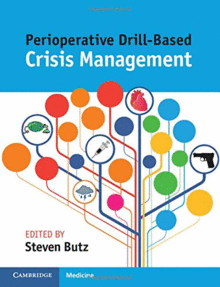
48,40 €It is essential that medical professionals in the operating room regularly undertake emergency drills. This unique book takes what can be an onerous task for leaders and operating room physicians, and makes it easy. Chapters cover drills ranging from medical emergencies such as cardiac arrest and malignant hyperthermia, to non-medical emergencies such as an active shooter and evacuation of a medical facility. Each chapter includes at least three scenarios for a specific type of drill, with expected actions and educational material for debriefing. The latest specialty guidelines and algorithms are included throughout and key learning points are highlighted for each drill, removing the need for further detailed research in advance of each exercise. Written and edited by leading experts in the field and endorsed by the Society for Ambulatory Anesthesia, this manual enables every reader to lead a meaningful drill with educational value for all participants.
- Consistent chapter structure with written scenarios and expected actions allows the reader to run an effective drill with little or no prior preparation
- Drills are generalizable, enabling facilities to run different drills for a long period of time without repetition and allowing adaptation for many different clinical settings and geographies
- Key learning points, guidelines and algorithms allow every reader to put together meaningful and educational drills on the spot
Author
Steven Butz is Associate Professor of Anesthesiology at the Medical College of Wisconsin, Milwaukee, and Medical Director at the Children's Hospital of Wisconsin Surgicenter, Milwaukee, WI, USA.
Table of Contents
List of contributors
Preface
Glossary
1. Cardiac arrest: acute coronary syndrome
2. Reversible causes of cardiac arrest
3. Malignant hyperthermia
4. Delayed emergence
5. Recovery room issues
6. Acute pulmonary embolism
7. Difficult airway
8. Local anesthetic systemic toxicity
9. Violence in the workplace: an active shooter in an ASC
10. Emergency preparedness and evacuation in an ASC
Index.
 -5%
-5%
 -5%
-5%
 -5%
-5%
 -5%
-5%
 -5%
-5%
 -5%
-5%
 -5%
-5%
 -5%
-5%
 -5%
-5%
 -5%
-5%