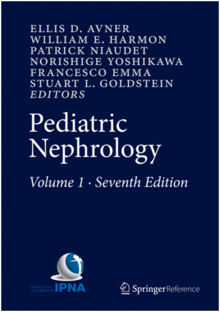
AVNER, E.; HARMON, W.; NIAUDET, P.; YOSHIKAWA, N.; EMMA, F.; GOLDSTEIN, S.
Descuento:
-5%Antes:
Despues:
1.284,39 €Table of contents (83 chapters)
1. Embryonic Development of the Kidney
2. Development of Glomerular Circulation and Function
3. Renal Tubular Development
4. Clinical Perinatal Urology
5. Renal Dysplasia/Hypoplasia
6. Developmental Syndromes and Malformations of the Urinary Tract
7. Physiology of the Developing Kidney: Sodium and Water Homeostasis and Its Disorders
8. Physiology of the Developing Kidney: Potassium Homeostasis and Its Disorder
9. Physiology of the Developing Kidney: Acid-Base Homeostasis and Its Disorders
10. Bone Developmental Physiology
11. Physiology of the Developing Kidney: Disorders and Therapy of Calcium and Phosphorous Homeostasis
12. Nutrition Management in Childhood Kidney Disease: An Integrative and Lifecourse Approach
13. Physiology of the Developing Kidney: Fluid and Electrolyte Homeostasis and Therapy of Basic Disorders (Na/H
14. Translational Research Methods: Basics of Renal Molecular Biology
15. Translational Research Methods: The Value of Animal Models in Renal Research
16. Basics of Clinical Investigation
17. Genomic Methods in the Diagnosis and Treatment of Pediatric Kidney Disease
18. Translational Research Methods: Renal Stem Cells
19. Translational Research Methods: Tissue Engineering of the Kidney and Urinary Tract
20. Clinical Evaluation of the Child with Suspected Renal Disease
21. Laboratory Investigation of the Child with Suspected Renal Disease
22. Growth and Development of the Child with Renal Disease
23. Diagnostic Imaging of the Child with Suspected Renal Disease
24. Pediatric Renal Pathology
25. Congenital Nephrotic Syndrome
26. Inherited Glomerular Diseases
27. Idiopathic Nephrotic Syndrome in Children: Genetic Aspects
28. Idiopathic Nephrotic Syndrome in Children: Clinical Aspects
29. Immune-Mediated Glomerular Injury in Children
30. Complement-Mediated Glomerular Injury in Children
31. Acute Postinfectious Glomerulonephritis in Children
32. Immunoglobulin A Nephropathies in Children (Includes HSP)
33. Membranoproliferative and C3-Mediated GN in Children
34. Membranous Nephropathy in Children
35. Nephronophthisis and Medullary Cystic Kidney Disease in Children
36. Childhood Polycystic Kidney Disease
37. Aminoaciduria and Glycosuria in Children
38. Renal Tubular Disorders of Electrolyte Regulation in Children
39. Renal Tubular Acidosis in Children
40. Nephrogenic Diabetes Insipidus in Children
41. Cystinosis and Its Renal Complications in Children
42. Pediatric Fanconi Syndrome
43. Primary Hyperoaxaluria in Children
44. Pediatric Tubulointerstitial Nephritis
45. Renal Involvement in Children with Vasculitis
46. Renal Involvement in Children with Systemic Lupus Erythematosus
47. Renal Involvement in Children with HUS
48. Sickle Cell Nephropathy in Children
49. Diabetic Nephropathy in Children
50. Renal Manifestations of Metabolic Disorders in Children
51. Infectious Diseases and the Kidney in Children
52. Nephrotoxins and Pediatric Kidney Injury
53. Urinary Tract Infections in Children
54. Vesicoureteral Reflux and Renal Scarring in Children
55. Pediatric Obstructive Uropathy
56. Pediatric Bladder Disorders
57. Urolithiasis in Children
58. Pediatric Renal Tumors
59. Epidemiology of Hypertension in Children
60. Pathophysiology of Pediatric Hypertension
61. Evaluation of Hypertension in Childhood Diseases
62. Management of the Hypertensive Child
63. Pathogenesis of Acute Kidney Injury
64. Evaluation and Management of Acute Kidney Injury in Children
65. Pathophysiology of Progressive Renal Disease in Children
66. Management of Chronic Kidney Disease in Children
67. Handling of Drugs in Children with Abnormal Renal Function
68. Endocrine and Growth Abnormalities in Chronic Kidney Disease
69. Mineral and Bone Disorders in Children with Chronic Kidney Disease
70. Peritoneal Dialysis in Children
71. Hemodialysis in Children
72. Immunology of Pediatric Renal Transplantation
73. Pediatric Renal Transplantation
74. Immunosuppression for Pediatric Renal Transplantation
75. Complications of Pediatric Renal Transplantation
76. IPNA: Global Pediatric Nephrology, Introduction and Overview
77. AFPNA
78. ALANEPE
79. AsPNA
80. Pediatric Nephrology in North America
81. ANZPNA
82. ESPN
83. JSPN
• Covers all clinically relevant aspects of congenital and acquired pediatric kidney diseases
• Includes many clinical algorithms
• Documents the latest treatment guidelines based on research findings
• Updates researchers through an expanded edition of a standard reference work
• Supports understanding of children’s kidney disease and appropriate treatment
This new edition of Pediatric Nephrology, now in three volumes, has been extensively updated and also contains much new material. Its organization flows logically from renal physiology to clinical evaluation. Discussion of the development of kidney structure and function is followed by sections on basic and translational research and on clinical methods, including laboratory tests, diagnostic imaging, and renal pathology. Comprehensive chapters then cover each of the childhood kidney diseases, grouped according to major disease categories. All of these chapters make new genetic information easily understandable for the practitioner and use many algorithms and diagrams to describe appropriate clinical evaluation of symptoms, differential diagnosis, specific diagnostics, and currently available therapies. Over the course of the previous six editions, Pediatric Nephrology has become the standard reference text for students, trainees, and practicing physicians (pediatricians, nephrologists, internists, and urologists), subspecialists, and allied health professionals seeking information about children’s kidney diseases. It is global in perspective, reflecting the fact that the international group of editors are all acknowledged world experts. This book serves as a superb reference and is an invaluable asset during clinical encounters with children having all forms of kidney disease.
Authors
• Ellis D. Avner, MD, is Professor of Pediatrics (Nephrology) and Professor of Physiology at the Medical College of Wisconsin, Milwaukee, USA and Director of the Clinical and Research Polycystic Kidney Disease Program, Children’s Hospital and Health System of Wisconsin. He was also Founding Director of the Children’s Research Institute, Children’s Hospital and Health System of Wisconsin. He has received many awards, including the Henry L. Barnett Award for Excellence in Clinical Care and Education in Pediatric Nephrology from the American Academy of Pediatrics. Dr. Avner has undertaken numerous review and advisory activities, including with the National Institutes of Health and has served on the editorial boards of many leading journals.
• William E. Harmon, MD, MA, has recently stepped down from his posts as Chief of the Division of Nephrology at Boston Children’s Hospital, Boston, Massachusetts, USA (a position he took up in 1987) and as Warren E. Grupe Chair in Pediatric Nephrology. Prior to the latter academic position, Dr. Harmon was Professor of Pediatrics at Harvard Medical School. During his long and distinguished career Dr. Harmon has held many important posts, including President of the American Society of Transplantation, Chairman of the Nation Kidney Foundation and President of the North American Pediatric Renal Transplant Cooperative Study.
• Patrick Niaudet, MD, is a Consultant at the Hôpital Necker-Enfants Malades, Paris, France, where he was previously Chairman of Pediatrics and Head of the Pediatric Nephrology Department. In 1986 Dr. Niaudet was appointed Professor of Pediatrics at University Paris-Descartes, Paris. From 2008 to 2011 he served as President of the Société de Néphrologie Pédiatrique and he is also President of the Ethical Committee of the French Biomedical Agency. Dr. Niaudet is Editor forPediatric Nephrology of “UpToDate” and is a past Assistant and Associate Editor of the journal.
• Norishige Yoshikawa, MD, has, since 2000, been Professor and Chair of Pediatrics at Wakayama Medical University, Wakayama, Japan, having previously been Professor of Health Science at Kobe University School of Medicine. He is current Vice-President of the Japanese Society of Pediatric Nephrology and an ex-Vice President of the Japan Pediatric Society. For the past 15 years he has been a Section Editor for Pediatric Nephrology and he has also served on the editorial board of theClinical Journal of American Society of Nephrology.
• Francesco Emma, MD, is Head of the Department of Nephrology & Urology at Bambino Gesù Children’s Hospital, IRCCS, Rome, Italy, where he also has responsibility for the Nephrology Research Laboratory. Dr. Emma is a member of the Scientific Review Board of the Cystinosis Research Foundation and a board member of the ERA-EDTA Working Group on Inherited Kidney Disorders. In 2012 he served as Chairman of the Scientific Committee for the 2012 meeting of the European Society of Pediatric Nephrology, Krakow, Poland.
• Stuart L. Goldstein, MD, is Professor of Pediatrics (affiliated) at University of Cincinnati School of Medicine, Cincinnati, Ohio, USA and is Director of the Center for Acute Care Nephrology at Cincinnati Children’s Hospital Medical Center. In 2013 he won the International “Vicenza” Award in Critical Care Nephrology. He has held numerous positions in professional societies and has served on various journal editorial boards. He is associate editor of Clinical Kidney Disease and is a Pediatric Nephrology section editor for Acute Kidney Injury/Critical Care Nephrology.
 -5%
-5%
 -5%
-5%
 -5%
-5%
 -5%
-5%
 -5%
-5%
 -5%
-5%
 -5%
-5%
 -5%
-5%
 -5%
-5%
 -5%
-5%