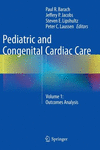
BARACH, P.; JACOBS, J.; LIPSHULTZ, S.; LAUSSEN, P.
Descuento:
-5%Antes:
Despues:
167,95 €There are growing questions regarding the safety, quality, risk management, and costs of PCC teams, their training and preparedness, and their implications on the welfare of patients and families. This innovative book, authored by an international authorship, will highlight the best practices in improving survival while paving a roadmap for the expected changes in the next 10 years as healthcare undergoes major transformation and reform. An invited group of experts in the field will participate in this project to provide the timeliest and informative approaches to how to deal with this global health challenge. The book will be indispensable to all who treat pediatric cardiac disease and will provide important information about managing the risk of patients with pediatric and congenital cardiac disease in the three domains of: the analysis of outcomes, the improvement of quality, and the safety of patients.
Features
- Novel approach looking at clinical issues
- Includes detailed review of best practices in congenital heart disease
- Highly informative for all who treat pediatric cardiac disease
Table of contents (37 chapters)
1.Introduction
2.Introduction: The History of Statistics in Medicine and Surgery
3.Introduction: Using Data to Drive Change and Improvement: The Legacy of Florence Nightingale
4.Introduction: Quality Improvement and Databases in the Context of Professionalism
5.Nomenclature for Congenital and Pediatric Cardiac Disease: Historical Perspectives and the International Pediatric and Congenital Cardiac Code
6.Defining Terms in Lists of Nomenclature
7.Illustrating Terms in Lists of Nomenclature
8.Databases for Assessing the Outcomes of the Treatment of Patients with Congenital and Pediatric Cardiac Disease: The Perspective of Cardiac Surgery
9.Databases for Assessing the Outcomes of the Treatment of Patients with Congenital and Pediatric Cardiac Disease: The Perspective of Cardiology
10.Databases for Assessing the Outcomes of the Treatment of Patients with Congenital and Pediatric Cardiac Disease: The Perspective of Anesthesia
11.Databases for Assessing the Outcomes of the Treatment of Patients with Congenital and Pediatric Cardiac Disease: The Perspective of Critical Care
12.Early Database Initiatives: The Fyler Codes
13.The Academic Database: Lessons Learned from the Congenital Heart Surgeons’ Society Data Center
14.Clinical Versus Administrative Data
15.Databases for Pediatric Cardiac Transplantation: The United Network for Organ Sharing/Scientific Registry of Transplant Recipients (UNOS/SRTR) and the Pediatric Heart Transplant Study (PHTS)
16.Databases for Extracorporeal Membrane Oxygenation and Ventricular Assist Devices
17.The United Kingdom National Congenital Heart Disease Audit
18.The Pediatric Cardiac Care Consortium: The End of an Era and Beginning of a New Mission
19.Pediatric Cardiac Catheterization Databases
20.Pediatric Electrophysiology Databases
21.Using Data to Drive Improvement and Build the Science of Nursing
22.Data Standards of the American College of Cardiology Foundation (ACCF) and the American Heart Association (AHA) and the Universal Pediatric Cardiac Dataset
23.Ethical Issues Confronting Outcomes Analysis and Quality Assurance
24.Statistical Issues in the Analysis and Interpretation of Outcomes for Congenital Cardiac Surgery
25.Real Time Monitoring of Risk-Adjusted Surgical Outcomes for Congenital Heart Disease
26.Risk Adjustment for Congenital Heart Surgery -1 (RACHS-1) for Evaluation of Mortality in Children Undergoing Cardiac Surgery
27.The Aristotle Complexity Score: A Tool to Evaluate Performance in Congenital Heart Surgery
28.Empirically Based Tools for Analyzing Mortality and Morbidity Associated with Congenital Heart Surgery
29.Verification of Data Completeness and Accuracy
30.Linking Databases
31.Use of National Death Registries to Empower Databases in Reporting Longitudinal Follow-Up
32.Quality of Life: The Need for a National Database
33.Longitudinal Follow-Up Studies in the Pediatric Heart Network
34.The Value of National Institutes of Health (NIH) Registry-Based Research in Identifying Childhood Cardiac Disease Outcomes: The Pediatric Cardiomyopathy Registry Experience
35.Public Reporting of Cardiac Data: Pros, Cons, and Lessons for the Future
36.Public Reporting of Pediatric Cardiac Data
37.Communication Chaos: How Incomplete and Conflicting Information Prevents Improved Outcomes for Patients with Pediatric and Congenital Cardiac Disease.
 -5%
-5%
 -5%
-5%
 -5%
-5%
 -5%
-5%
 -5%
-5%
 -5%
-5%
 -5%
-5%
 -5%
-5%
 -5%
-5%
 -5%
-5%
 -5%
-5%