Descuento:
-5%Antes:
Despues:
36,06 ۥ Part 1 Introduction 1
1 Setting the scene 2
2 Managing the needs of family caregivers 4
3 Principles of effective communication 6
4 Advance care planning 8
5 Delivering palliative approaches in different care contexts 10
6 Integrated care pathways 12
• Part 2 Clinical applications 15
7 Principles of symptom management 16
8 Best practice in pain management 18
9 Managing pain 20
10 Complex pain problems and treatment challenges 22
11 Managing nausea and vomiting 24
12 Managing constipation 26
13 Understanding depression 28
14 Understanding delirium and confusion 30
15 Managing myoclonus, tremors and muscle spasms 32
16 Managing lymphoedema 34
17 Managing hypercalcaemia of malignancy 36
18 Assessing and managing oral hygiene 38
19 Caring for people with dysphagia 40
20 Managing breathlessness 42
21 Cough and haemoptysis 44
22 Explaining and exploring cachexia, anorexia and fatigue 46
23 Continual subcutaneous infusion: using a syringe pump 48
24 Emergencies: superior vena cava obstruction 50
25 Emergencies: haemorrhage 52
26 Emergencies: malignant spinal cord compression 54
27 Chemotherapy 56
28 Radiotherapy 58
• Part 3 Palliative care for all 61
29 Palliative care approaches in heart failure 62
30 Palliative care approaches to chronic obstructive pulmonary disease 64
31 Palliative care approaches in motor neurone disease 66
32 Palliative care approaches for people receiving dialysis 68
33 Palliative care approaches for people with progressive kidney disease: a non-dialytic pathway 70
34 Care of the patient following a stroke 72
35 Principles of palliative care for older people 74
36 Care of the person with dementia 76
37 Care for people with mental illness 78
38 Care for people with learning disabilities 80
39 Care for the homeless person 82
40 Care for people in prison 84
• Part 4 Professional roles in palliative care 87
41 Understanding rehabilitation in palliative care 88
42 The social worker 90
43 The occupational therapist 92
44 The physiotherapist 94
45 Complementary and supportive therapy 96
46 The clinical nurse specialist 98
47 The advanced nurse practitioner 100
48 The nurse consultant 102
49 The chaplain 104
50 The medical consultant 106
• Part 5 Ethical challenges in palliative care practice 109
51 Stress in palliative care nursing 110
52 Responses to euthanasia and physician-assisted suicide 112
53 Withholding and withdrawing life-sustaining care 114
54 Recognising and planning for the terminal phase of life 116
• Part 6 Managing end-of-life care 119
55 Changing goals of care at the end of life 120
56 Managing respiratory secretions at the end of life 122
57 Care at the moment of death 124
58 Spiritual perspectives at the end of life 126
59 Bereavement 128
Index 131
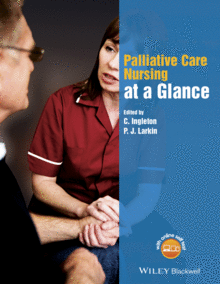
Palliative Care Nursing at a Glance is the perfect companion for nursing students, health and social care practitioners, and all those involved in palliative care delivery, both in the clinical and home setting. Written by an expert team of academics, nurses, educators and researchers it provides a concise and easy-to-read overview of all the concepts and clinical decision-making skills necessary for the provision of good-quality palliative and end-of-life care.
Divided into six sections, the book includes coverage of all key clinical applications, principles of symptom management, palliative care approaches for a range of conditions and patient groups, exploration of the roles of the multi-professional team, as well as ethical challenges.
• Superbly illustrated, with full colour illustrations throughout
• Provides information on delivery of care in a range of settings
• Broad coverage makes it ideal reading for anyone involved in palliative care delivery
• User-friendly and accessible resource for those working in both specialist and non-specialist adult settings
 -5%
-5%
 -5%
-5%
 -5%
-5%
 -5%
-5%
 -5%
-5%
 -5%
-5%
 -5%
-5%
 -5%
-5%
 -5%
-5%
 -5%
-5%