Descuento:
-5%Antes:
Despues:
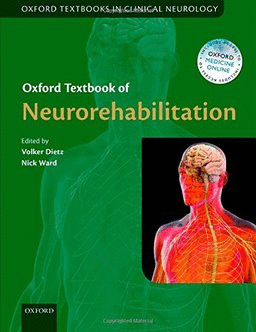
140,98 €- Clinical recommendations that are based on a mix of established evidence and clinical experience
- Will provide an understanding of the theoretical underpinnings of neurorehabilitation
- The Editors are well known and respected in the emergent field of neurorehabilitation
Neurorehabilitation is an expanding field with an increasing clinical impact because of an ageing population. During the last 20 years neurorehabilitation has developed from a discipline with little scientific background, separated from other medical centers, to a medical entity largely based on the principles of 'evidenced based medicine' with strong ties to basic research and clinical neurology. Today neurorehabilitation is still a 'work in progress' and treatment standards are not yet established for all aspects of neurorehabilitation. There are very few books that address contemporary neurorehabilitation from this perspective.
This volume moves the reader from theory to practice. It provides the reader with an understanding of the theoretical underpinnings of neurorehabilitation, as well as a clear idea about how (and why) to approach treatment decisions in individual patients. These clinical recommendations are based on a mix of established evidence and clinical experience that the authors bring to bear on their topics.
Readership: The volume is aimed at a broad range of clinicians. It will appeal particularly to neurologists, general practitioners and clinical psychologists specializing in neurorehabilitation, and allied health care professionals in physiotherapy, occupational therapy and speech and language therapists involved in neurorehabilitation.
Authors
- Volker Dietz, Professor emeritus, University Hospital Balgrist, Zürich, Switzerland, and Nick Ward, Reader in Clinical Neurology & Honorary Consultant Neurologist, Department of Motor Neuroscience, UCL Institute of Neurology and The National Hospital for Neurology and Neurosurgery, Queen Square, London, UK.
- Dr. Nick Ward, Department of Motor Neuroscience, UCL Institute of Neurology and The National Hospital for Neurology and Neurosurgery, Queen Square, London, UK.
CONTENTS:
SECTION I: General aspects of neurorehabilitation
The international classification of functioning, disability and health
An interdisciplinary approach to neurological rehabilitation
The economic benefits of rehabilitation for neurological conditions
Predicting activities after stroke
Designing a clinical trial for rehabilitation
The influence of age on neurorehabilitation
The relationship of motor learning to neurorehabilitation
SECTION II: Physiological consequences of CNS damage
Spinal neuronal dysfunction after deprivation of supraspinal input
Secondary changes after damage of the central nervous system: Significance of spastic muscle tone in rehabilitation
Autonomic nervous system dysfunction
Functional recovery in CNS disease: Impact of animal models
SECTION III: Neuroplasticity and repair
Animal models of damage, repair and plasticity in the brain
Animal models of damage, repair, and plasticity in the spinal cord
Stem cell application in neurorehabilitation
The role of neuroimaging in understanding the impact of neuroplasticity after CNS damage
Enhancement of neuroplasticity by cortical stimulation
Enhancement of neuroplasticity by drug therapy
SECTION IV: Clinical concepts
Rehabilitation of gait and balance after CNS damage
Neurorehabilitation approaches for disorders of the peripheral nervous system
Treatment of arm and hand dysfunction after CNS damage
Acquired disorders of language and their treatment
Neuropsychological rehabilitation of higher cortical functions after brain damage
The clinical neurology of problems with oral feeding
Management of bladder, bowel, and sexual dysfunction
The assessment and treatment of pain syndromes in neurorehabilitation
The impact of fatigue on neurorehabilitation
Neuropalliative rehabilitation - managing neurological disability in the context of a deteriorating illness
Recognition and management of functional (non-organic) symptoms after CNS damage
SECTION V: Technical concepts
Promises and challenges of neurorehabilitation technology
Application of orthoses and neurostimulation in neurorehabilitation
Technology to enhance arm and hand function
Technology to enhance locomotor function
Enhancing independent community access and participation: Services, technologies and policies
Virtual reality for neurorehabilitation
 -5%
-5%
 -5%
-5%
 -5%
-5%
 -5%
-5%
 -5%
-5%
 -5%
-5%
 -5%
-5%
 -5%
-5%
 -5%
-5%
 -5%
-5%