Descuento:
-5%Antes:
Despues:
128,43 €1. Introduction
2. CHA2DS2-VASc and HAS-BLED Risk Stratification Tools
3. Male with Priority of Ischemic Stroke Reduction
4. Choosing an Anticoagulant in an Elderly Patient
5. Patient with Prior History of GI Hemorrhage
6. Patients with a History of Intracranial Hemorrhage
7. Concerns with Anticoagulant Adherence
8. Oral Anticoagulants in Stable Moderate Chronic Kidney Disease
9. Oral Anticoagulants in Severe Renal Dysfunction
10. Oral Anticoagulants in Patients with Variable Renal Function
11. Patient with Concomitant Stable Coronary Artery Disease
12. Patient with Concomitant Acute Venous Thromboembolism
13. Patient with Concomitant Mitral Valve Stenosis
14. Patient with Concomitant Aortic Valve Stenosis
15. Best Practice for Switching Stable Warfarin Patients
16. Patient-Centered Strategies for Improving Warfarin Management
17. Provoked Versus Unprovoked Venous Thromboembolism
18. Venous Thromboembolism (VTE) Prophylaxis in Hip and Knee Replacement Surgery
19. Venous Thromboembolism (VTE) Prophylaxis in the Intensive Care Unit (ICU)
20. VTE and Recent Drug Eluting Stent (DES) Placement
21. Acute VTE in a Patient with Moderate Chronic Kidney Disease
22. Oral Anticoagulation and Duration in Recurrent Venous Thromboembolism (VTE)
23. Pulmonary Embolism (PE) with Thrombolytic Therapy
24. Patient on Oral Anticoagulant Presenting with ACS
25. Oral Anticoagulant Therapy Post-Percutaneous Coronary Intervention
26. ST-Segment Elevation Myocardial Infarction (Lytic Candidate) on Oral Anticoagulant
27. ACS with Bypass Surgery
28. Anticoagulant Drug-Drug Interactions with CYP 3A4 Inhibitors
29. Significance of P-glycoprotein (P-gp) Drug-Drug Interactions
30. Considerations with Pharmacodynamic Drug-Drug Interactions
31. Management of Direct Oral Anticoagulants with Mixed P-gp/3A4 Drug-Drug Interactions
32. Pharmacokinetic Drug-Drug Interactions with Warfarin
33. Chronic Pain Management with Anticoagulation
34. Anticoagulation Management in Atrial Fibrillation Catheter Ablation
35. Anticoagulation Management Considerations for Mechanical Valves
36. Management of Antiphospholipid Antibody Syndrome
37. Venous Thromboembolism and Pregnancy
38. Venous Thromboembolism in Active Malignancy
39. Anticoagulation Management in Patients Undergoing Gastric Bypass Procedures
40. Patient Presenting with Minor Bleeding
41. Patient Presenting with Major, Life-Threatening Bleeding
42. Overdose of Dabigatran
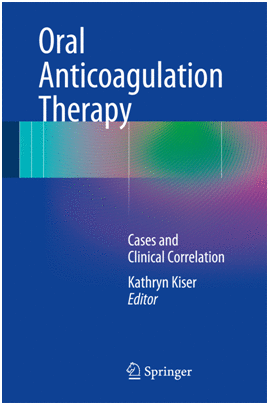
Given the amount and complexity of information surrounding the the target specific oral anticoagulants a lengthy didactic educational format has the potential to be overwhelming to the reader and difficult to translate and apply to direct patient care. The proposed book will educate clinicians utilizing a series of clinical cases to simultaneously develop the readers’ knowledge base, problem-solving skills, and practically apply their new knowledge to a variety of clinical situations. These will be short focused case presentations that provide critical information and pose questions to the reader at key points in the decision making process. The cases will be relevant to what clinicians will encounter not only on a daily basis, but also reflective of scenarios that clinicians will not encounter regularly, but that they will have to act upon (e.g. a bleeding patient, patient scheduled for elective or emergent procedure, patient with changing renal function, patient on drugs that have a plausible yet unstudied drug interaction with a target specific oral anticoagulant etc). Included in the case studies will be evidence-based discussions (with appropriate references) that provide immediate feedback on the different treatment alternatives that were offered. The case studies will be designed to instruct the reader how to select and effectively utilize the most appropriate agent for a given clinical scenario. They will focus on key features of the target specific oral anticoagulants, what they have in common, how they are unique from each other, as well as illustrating the clinical decision process one should take when selecting an agent or managing a patient already receiving one of the target specific oral agents.
Features
• Focuses on practical considerations with the target specific oral anticoagulants utilizing a series of clinical cases to illustrate key points Encompasses the multiple disease states in which these agents have been approved for use
• Contains self-assessment questions available on-line to reinforce key concepts and critical features of the drugs
Authors
Katie Kiser, Pharm.D., BCACP received her Bachelor of Science in Biology from King University in Bristol, Tennessee and her Doctor of Pharmacy from the University of North Carolina School of Pharmacy in Chapel Hill, North Carolina. She completed her postgraduate year-one residency with emphasis in ambulatory care at Moses Cone Health System in Greensboro, North Carolina and her postgraduate year-tworesidency in ambulatory care at the University of North Carolina Hospitals in Chapel Hill, North Carolina. Dr. Kiser is faculty at South College School of Pharmacy in Knoxville, Tennessee and previously taught at the University of Maryland School of Pharmacy in Baltimore, Maryland.
Dr. Kiser has over 10 years of clinical and teaching experience in anticoagulation management and is a Board of Pharmaceutical Specialties certified Ambulatory Care Pharmacist. Dr. Kiser has practiced primarily in the outpatient clinical setting and served as the Director of the UHC Antithrombosis Clinic in Baltimore, Maryland from 2010 – 2014. Her current clinical practice is at NHC HealthCare in Farragut, Tennessee where she serves as a consultant pharmacist and specializes in oral anticoagulant management in a diverse rehabilitation and long term care population.
Dr. Kiser is an Associate Editor and co-founder of iForumRx.org which is an interactive web-based community designed to inform ambulatory care clinicians about high-quality, practice-changing evidence. Dr. Kiser is highly involved with the American College of Clinical Pharmacy and has served in local and national leadership positions She has written chapters in a leading pharmacy textbook and has participated in clinical research and written many peer-reviewed articles on anticoagulation, health literacy, the scholarship of teaching, and other topics.
 -5%
-5%
 -5%
-5%
 -5%
-5%
 -5%
-5%
 -5%
-5%
 -5%
-5%
 -5%
-5%
 -5%
-5%
 -5%
-5%
 -5%
-5%