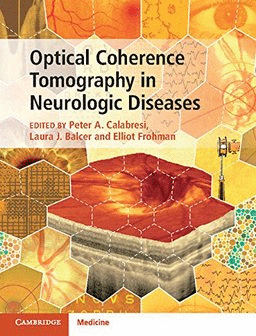
CALABRESI, P.; BALCER, L.; FROHMAN, E.
Descuento:
-5%Antes:
Despues:
141,46 €Optical coherence tomography (OCT) provides tissue morphology imagery at much higher resolution than other imaging modalities such as MRI or ultrasound, and the machines are comparatively cheaper. It is an easy technique to perform; is non-ionizing, and therefore safe. These benefits are driving a rapid transformation of OCT, from its principal application as a research tool, into an extension of the 'neurological examination' in routine office practice. Originally used in assessing the severity of tissue damage and prognosis of multiple sclerosis and various neuro-ophthalmic conditions, OCT is increasingly used in other neurological disorders such as Parkinson's disease, ALS, and Alzheimer's disease. This book is the first comprehensive review of the use of OCT in neurological diseases. The coverage includes a description of the technique and its utilization in a variety of neurologic conditions. Essential reading for neurologists, neuro-ophthalmologists, and neuroradiologists wanting an introductory account of the clinical applications of OCT.
- The first comprehensive review of the clinical use of OCT in a wide range of neurological diseases
- Practical, reflecting the rapid move of OCT into routine office practice
- Extensively illustrated in color, with sample case-histories and the expertise of leading physicians
Authors
Peter A. Calabresi, Department of Neurology, Johns Hopkins University Hospital, Baltimore. Professor of Neurology, Director of the Richard T. Johnson Division of Neuroimmunology and Neuroinfectious. Diseases, and Director of the Johns Hopkins Multiple Sclerosis Center, Johns Hopkins University School of Medicine, Baltimore, Maryland, USA.
Laura J. Balcer, Department of Neurology, NYU Langone Medical Center, New York. Professor and Vice Chair, Department of Neurology, New York University Langone Medical Center, New York, USA.
Elliot M. Frohman, Department of Neurology, UT Southwestern Medical Center, Dallas. Professor of Neurology, Department of Neurology, University of Texas Southwestern Medical Center, Dallas, Texas,USA.
Contents
Preface
1. Introduction to optical coherence tomography in neurological diseases.
2. Basic principles of optical coherence tomography.
3. Anatomy of the anterior visual pathway.
4. Optical coherence tomography in acute optic neuritis.
5. Optical coherence tomography and visual outcomes in acute optic neuritis.
6. Optical coherence tomography and low contrast acuity.
7. Optical coherence tomography and electrophysiology of the visual pathway.
8. Optical coherence tomography and electrophysiology of the optic nerve head.
9. Meta-analysis of optical coherence tomography in multiple sclerosis.
10. Optical coherence tomography and brain MRI in multiple sclerosis.
11. Optical coherence tomography in neurodegenerative diseases.
12. Optical coherence tomography pathologies to know about in clinical practice.
13. Optical coherence tomography and retinal segmentation in neurological diseases.
14. Optical coherence tomography and retinal pathology in neurologic diseases.
15. Retinal inflammation in MS revealed by optical coherence tomography and ophthalmoscopy.
16. Optical coherence tomography and optic nerve MRI in demyelinating diseases.
17. Optical coherence tomography in neurologic clinical trials.
18. Optical coherence tomography in multi-center setting: quality control issues.
19. Future technological advances in optical coherence tomography.
Index.
 -5%
-5%
 -5%
-5%
 -5%
-5%
 -5%
-5%
 -5%
-5%
 -5%
-5%
 -5%
-5%
 -5%
-5%
 -5%
-5%
 -5%
-5%