TAGUCHI, T.; IWANAKA, T.; OKAMATSU, T.
Descuento:
-5%Antes:
Despues:
167,95 €1. Vascular Access
2. Thoracotomy and Laparotomy
3. Laparoscopy and Thoracoscopy
4. Foreign Body Extraction
5. Tracheostomy
6. Tube Gastrostomy and Enterostomy
7. Colostomy: Creation and Closure
8. Gastrointestinal Anastomosis
9. Repair and Anastomosis of the Blood Vessel
10. Biopsy of Tumor
11. Rectal Biopsy
12. Head and Neck Sinus and Mass
13. Pyriform Sinus Malformation
14. Accessory Ear and Cervical Ear
15. Standard Operation for Esophageal Atresia
16. Esophageal Atresia with Long Gap
17. Thoracoscopic Operation for Esophageal Atresia
18. Lung Surgery
19. Thoracic Empyema
20. Congenital Diaphragmatic Hernia and Diaphragmatic Eventration
21. Inguinal Hernia: Standard Procedure
22. Inguinal Hernia: Laparoscopic Repair
23. Direct Inguinal Hernia and Femoral Hernia
24. Hydrocele, Nuck Hydrocele: Standard Procedure
25. Umbilical Hernia, Umbilical Plasty, and Linea Alba Hernia
26. Vitellointestinal Fistula and Urachal Remnant
27. Gastroschisis and Omphalocele
28. Laparoscopic Nissen’s Fundoplication
29. Pyloromyotomy
30. Duodenal Atresia and Stenosis
31. Intestinal Atresia and Stenosis
32. Intestinal Malrotation
33. Meckel’s Diverticulum
34. Internal Hernia
35. Intussusception
36. Appendectomy
37. Gastrointestinal Perforation
38. Hirschsprung’s Disease
39. Imperforate Anus: Low Type
40. Imperforate Anus: Intermediate and High Type
41. Rectovestibular Fistula Without Imperforate Anus (Perineal Canal)
42. Anal Fistula
43. Anorectal Prolapse
44. Biliary Atresia
45. Choledochal Cyst
46. Splenectomy
47. Portal Vein Hypoplasia and Patent Ductus Venosus
48. Pyeloplasty
49. Vesicoureteral Reflux (VUR)
50. Ureterocele
51. Suprapubic Cystostomy and Vesicocutaneostomy
52. Bladder Augmentation
53. Posterior Sagittal Anorecto-Urethro-Vaginoplasty
54. Hypospadias
55. Posterior Urethral Valve
56. Phimosis
57. Cryptorchidism and Retractile Testis
58. Testicular Torsion
59. Lymphatic Malformations
60. Neuroblastoma
61. Wilms’ Tumor
62. Hepatoblastoma
63. Sacrococcygeal Teratoma
64. Donor Operation in Living Donor Liver Transplantation
65. Recipient Operation in Living Donor Liver Transplantation
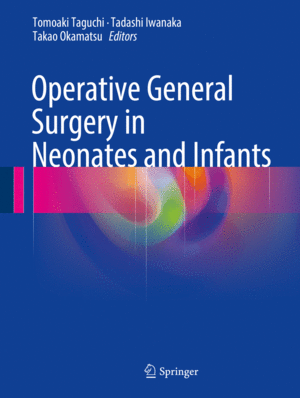
This book focuses on standard operative techniques for important diseases in pediatric surgery, especially in neonates and infants, while also offering a wealth of schematic drawings and photographs to help readers understand the surgical techniques. Because of the rarity of the diseases and shortage of advising doctors, operative techniques for neonatal and infant surgery are difficult to learn. In order to understand essential operative procedures, schematic drawings and suitable intraoperative photographs are called for. Operative General Surgery in Neonates and Infants was written by leading experts in pediatric surgery with extensive experience in their respective fields. The contents provide detailed practical advice on the surgical procedures and perioperative management in neonates and infants. This book is a valuable guide for trainees and a helpful refresher text for specialized pediatric surgeons and can also be used to explain operative procedures to parents.
Features
• Serves as a clearly structured surgical guide with many detailed illustrations for each disease
• Includes the latest topics in operative procedures
• Provides a quick and intelligible reference for pediatric surgeons and trainees alike
Authors
• Tomoaki Taguchi, MD Ph.D., FACS Department of Pediatric Surgery, Graduate School of Medical Sciences, Kyushu University, Japan
• Tadashi Iwanaka, MD Ph.D.Director, Saitama Children's Medical Center, Japan
• Takao Okamatsu, MD Ph.D.Director of Foundation for International Development/Relief (FIDR), Japan
 -5%
-5%
 -5%
-5%
 -5%
-5%
 -5%
-5%
 -5%
-5%
 -5%
-5%
 -5%
-5%
 -5%
-5%
 -5%
-5%
 -5%
-5%