Descuento:
-5%Antes:
Despues:
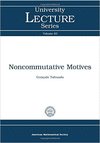
48,41 €The theory of motives began in the early 1960s when Grothendieck envisioned the existence of a "universal cohomology theory of algebraic varieties". The theory of noncommutative motives is more recent. It began in the 1980s when the Moscow school (Beilinson, Bondal, Kapranov, Manin, and others) began the study of algebraic varieties via their derived categories of coherent sheaves, and continued in the 2000s when Kontsevich conjectured the existence of a "universal invariant of noncommutative algebraic varieties". This book, prefaced by Yuri I. Manin, gives a rigorous overview of some of the main advances in the theory of noncommutative motives. It is divided into three main parts. The first part, which is of independent interest, is devoted to the study of DG categories from a homotopical viewpoint. The second part, written with an emphasis on examples and applications, covers the theory of noncommutative pure motives, noncommutative standard conjectures, noncommutative motivic Galois groups, and also the relations between these notions and their commutative counterparts. The last part is devoted to the theory of noncommutative mixed motives. The rigorous formalization of this latter theory requires the language of Grothendieck derivators, which, for the reader's convenience, is revised in a brief appendix.
Readership
Graduate students and research mathematicians interested in algebraic geometry, including non-commutative algebraic geometry.
About the Author
Goncalo Tabuada , Massachusetts Institute of Technology, Cambridge, MA, USA.
Contents
Preface ix
Introduction 1
Chapter 1. Differential graded categories 3
1.1. Definitions 3
1.2. Quasi-equivalences 5
1.3. Drinfeld’s DG quotient 11
1.4. Pretriangulated equivalences 13
1.5. Bondal-Kapranov’s pretriangulated envelope 14
1.6. Morita equivalences 15
1.7. Kontsevich’s smooth proper dg categories 16
Chapter 2. Additive invariants 21
2.1. Definitions 21
2.2. Examples 22
2.3. Universal additive invariant 26
2.4. Computations 29
2.5. Lefschetz’s fixed point formula 32
Chapter 3. Background on pure motives 35
Chapter 4. Noncommutative pure motives 41
4.1. Noncommutative Chow motives 41
4.2. Relation with Chow motives 41
4.3. Relation with Merkurjev-Panin’s motives 46
4.4. Noncommutative ?-nilpotent motives 47
4.5. Noncommutative homological motives 47
4.6. Noncommutative numerical motives 48
4.7. Kontsevich’s noncommutative numerical motives 49
4.8. Semi-simplicity 50
4.9. Noncommutative Artin motives 52
4.10. Functoriality 53
4.11. Weil restriction 54
Chapter 5. Noncommutative (standard) conjectures 57
5.1. Standard conjecture of type Cnc 57
5.2. Standard conjecture of type Dnc 58
5.3. Noncommutative nilpotence conjecture 59
5.4. Kimura-finiteness 59
5.5. All together 60
Chapter 6. Noncommutative motivic Galois groups 63
6.1. Definitions 63
6.2. Relation with motivic Galois groups 65
6.3. Unconditional version 65
6.4. Base-change short exact sequence 66
Chapter 7. Jacobians of noncommutative Chow motives 69
Chapter 8. Localizing invariants 71
8.1. Definitions 71
8.2. Examples 72
8.3. Universal localizing invariant 73
8.4. Additivity 77
8.5. A1-homotopy 79
8.6. Algebraic K-theory 82
8.7. Witt vectors 84
8.8. Natural transformations 85
Chapter 9. Noncommutative mixed motives 87
9.1. Definitions 87
9.2. Relation with noncommutative Chow motives 89
9.3. Weight structure 89
9.4. Relation with Morel-Voevodsky’s motivic homotopy theory 90
9.5. Relation with Voevodsky’s geometric mixed motives 91
9.6. Relation with Levine’s mixed motives 93
9.7. Noncommutative mixed Artin motives 93
9.8. Kimura-finiteness 94
9.9. Coefficients 95
Chapter 10. Noncommutative motivic Hopf dg algebras 97
10.1. Definitions 97
10.2. Base-change short exact sequence 98
Appendix A. Grothendieck derivators 99
A.1. Definitions 99
A.2. Left Bousfield localization 101
A.3. Stabilization and spectral enrichment 102
A.4. Filtered homotopy colimits 102
A.5. Symmetric monoidal structures 103
Bibliography 105
Index 113
 -5%
-5%
 -5%
-5%
 -5%
-5%
 -5%
-5%
 -5%
-5%
 -5%
-5%
 -5%
-5%
 -5%
-5%
 -5%
-5%
 -5%
-5%