Descuento:
-5%Antes:
Despues:
118,55 €1. The Difficult Conversation.
2. Communication Between Teams and Multidisciplinary Rounds and Single Primary POC for Family Communication - Lessons Learned and Who's in Charge?.
3. Mass Casualty Events and Your Hospital.
4. Rural and Austere Environments.
5. Prehospital Care and EMS Considerations in the Polytrauma Patient with CNS Injuries.
6. AIS vs. ISS vs. GCS – What’s Going On Here?.
7. Trauma Resuscitation and Fluid Considerations in the Polytrauma Patient with CNS Injury.
8. Initial Imaging Considerations, Repeat Imaging Frequency.
9. Evidence Based Review of the Use of Steroids in Neurotrauma.
10. Interventional Radiology in the Civilian Neurotrauma Setting.
11. Vertebral artery injuries in penetrating neck and cervical spine trauma.
12. Clearing the Cervical Spine in Blunt Trauma.
13. Initial evaluation and management.
14. Transport of the Neurotrauma Patient.
15. Multiple Surgical Teams in the O. R. at Once – Priority of Effort and Who Takes the Lead?.
16. Laparotomy for refractory ICP.
17. Associated Musculoskeletal Injuries.
18. Neuro Anesthetic Considerations.
19. Decompressive Craniectomy for Severe TBI.
20. Hemodynamic Considerations in the Polytrauma Patient with Traumatic Brain Injury (TBI).
21. Coagulopathy in Traumatic Brain Injury.
22. Venous Thromboembolism Prophylaxis.
23. Mechanical Ventilation in Traumatic Brain Injury.
24. Nutrition, Antibiotics, and Posttraumatic Seizure Prophylaxis.
25. Therapeutic Hypothermia for Traumatic Brain Injury and Spinal Cord Injury.
26. Rehabilitation in the setting of Neuro-Trauma.
27. Craniofacial Reconstruction in the Polytrauma Patient.
28. Functional Restoration for Neurological Trauma: Current Therapies and Future Directions.
29. Pediatric Neurotrauma.
30. Care of Patients with Burns and Traumatic Brain Injury.
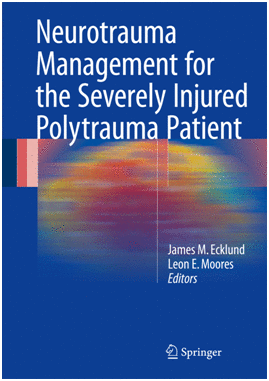
This text addresses many of the questions which occur when medical professionals of various disciplines interact and have different plans and interventions, each with its own valid scientific and/or experience-based rationale: Questions involving tourniquet placement, ideal fluids and volumes for resuscitation, VTE prophylaxis and many other management considerations. Straightforward decisions in the patient with a single diagnosis often conflict when applied to the neurologically injured polytrauma patients. Neurotrauma Management for the Severely Injured Polytrauma Patient answers as many of these questions as possible based on the current literature, vast experience with severe neurotrauma in the current conflicts in Afghanistan and Iraq, and the experience of trauma experts across the globe as well as proposes areas for future study where answers are currently less clear.
Features
• Written by experts across multiple disciplines
• Authors have vast experience with severe neurotrauma
• Addresses many of the questions which occur when medical professionals of various disciplines interact
Authors
• James M. Ecklund, M.D., F.A.C.S. serves as Chairman of the Inova Neuroscience Institute. Prior to joining Inova Medical Group, he served as Professor and Chairman of the Neurosurgery Program of the National Capital Consortium, which includes Walter Reed Army Medical Center, National Naval Medical Center and the Uniformed Services University. He is a retired colonel in the U.S Army and was deployed as a Neurosurgeon to both Afghanistan and Iraq. His program received the vast majority of American neurotrauma casualties.
• Dr. Ecklund’s primary clinical and research interests include complex spine, cerebrovascular disease and neurotrauma with an emphasis on blast and penetrating injury. He directs a neurotrauma laboratory at the Uniformed Services University, has over 100 publications and abstracts, and has lectured throughout the world. He also has served on multiple oversight and advisory boards for the Veterans Administration, Department of Defense, National Institutes of Health, NATO, Neurotrauma Foundation, and Brain Trauma Foundation.
 -5%
-5%
 -5%
-5%
 -5%
-5%
 -5%
-5%
 -5%
-5%
 -5%
-5%
 -5%
-5%
 -5%
-5%
 -5%
-5%
 -5%
-5%