Descuento:
-5%Antes:
Despues:
167,95 €1. Learning in the Damaged Brain/Spinal Cord: Neuroplasticity
2. Movement Neuroscience Foundations of Neurorehabilitation
3. Designing Robots That Challenge to Optimize Motor Learning
4. Multisystem Neurorehabilitation in Rodents with Spinal Cord Injury
5. Sensory-Motor Interactions and Error Augmentation
6. Normal and Impaired Cooperative Hand Movements: Role of Neural Coupling
7. Clinical Assessment and Rehabilitation of the Upper Limb Following Cervical Spinal Cord Injury
8. Application Issues for Robotics
9. The Human in the Loop
10. Robotic and Wearable Sensor Technologies for Measurements/Clinical Assessments
11. Clinical Aspects for the Application of Robotics in Locomotor Neurorehabilitation
12. Clinical Application of Robotics and Technology in the Restoration of Walking
13. Standards and Safety Aspects for Medical Devices in the Field of Neurorehabilitation
14. Clinical Application of Rehabilitation Technologies in Children Undergoing Neurorehabilitation
15. Restoration of Hand Function in Stroke and Spinal Cord Injury
16. Forging Mens et Manus: The MIT Experience in Upper Extremity Robotic Therapy
17. Three-Dimensional Multi-degree-of-Freedom Arm Therapy Robot (ARMin)
18. Implementation of Impairment-Based Neurorehabilitation Devices and Technologies Following Brain Injury
19. Technology of the Robotic Gait Orthosis Lokomat
20. Beyond Human or Robot Administered Treadmill Training
21. Toward Flexible Assistance for Locomotor Training: Design and Clinical Testing of a Cable-Driven Robot for Stroke, Spinal Cord Injury, and Cerebral Palsy
22. Robot-Aided Gait Training with LOPES
23. Robotic Devices for Overground Gait and Balance Training
24. Using Robotic Exoskeletons for Over-Ground Locomotor Training
25. Functional Electrical Stimulation Therapy: Recovery of Function Following Spinal Cord Injury and Stroke
26. Passive Devices for Upper Limb Training
27. Upper-Extremity Therapy with Spring Orthoses
28. Virtual Reality for Sensorimotor Rehabilitation Post Stroke: Design Principles and Evidence
29. Wearable Wireless Sensors for Rehabilitation
30. BCI-Based Neuroprostheses and Physiotherapies for Stroke Motor Rehabilitation
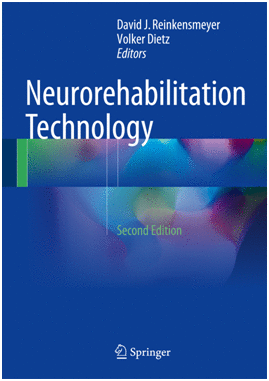
This revised, updated second edition provides an accessible, practical overview of major areas of technical development and clinical application in the field of neurorehabilitation movement therapy. The initial section provides a rationale for technology application in movement therapy by summarizing recent findings in neuroplasticity and motor learning. The following section then explains the state of the art in human-machine interaction requirements for clinical rehabilitation practice. Subsequent sections describe the ongoing revolution in robotic therapy for upper extremity movement and for walking, and then describe other emerging technologies including electrical stimulation, virtual reality, wearable sensors, and brain-computer interfaces. The promises and limitations of these technologies in neurorehabilitation are discussed. Throughout the book the chapters provide detailed practical information on state-of-the-art clinical applications of these devices following stroke, spinal cord injury, and other neurologic disorders. The text is illustrated throughout with photographs and schematic diagrams which serve to clarify the information for the reader.
Neurorehabilitation Technology, Second Edition is a valuable resource for neurologists, biomedical engineers, roboticists, rehabilitation specialists, physiotherapists, occupational therapists and those training in these fields.
Features
• Draws together international expertise in technology supporting neurorehabilitation and its clinical application in the field
• Consolidates the significant advances in this field over the last twenty years and the implications for clinical practice in neurorehabilitation
• Explains the physiological requirements for effective application of technologies and the limitations of technologies in neurorehabilitation
• Reflects the appropriate utilization of such technologies in the rehabilitation of neurologic patients following stroke, spinal cord injury, traumatic brain injury and movement disorders due to neurological diseases, generating considerable interest in this new and exciting area of medicine
Authors
• David Reinkensmeyer is Professor in the Departments of Mechanical and Aerospace Engineering, Anatomy and Neurobiology, Biomedical Engineering, and Physical Medicine and Rehabilitation at the University of California Irvine. His research interests are in neuromuscular control, motor learning, robotics, and rehabilitation. A major goal of his research is to develop physically interacting, robotic and mechatronic devices to help the nervous system recover the ability to control movement of the arm, hand, and leg after neurologic injuries such as stroke and spinal cord injury. He is also investigating the computational mechanisms of human motor learning in order to provide a rational basis for designing movement training devices. He is Editor-in-Chief of the Journal of Neuroengineering and Rehabilitation. His laboratory has helped develop a variety of robotic devices for manipulating and measuring movement in humans and rodents, including two devices that have been successfully commercialized as Flint Rehabilitation’s MusicGlove and as Hocoma’s ArmeoSpring.
• Volker Dietz, neurologist, is Professor emeritus and former Director of Spinal Cord Injury Center and Chair of Paraplegiology, University of Zürich, Balgrist Hospital, Switzerland. His research is focused on neuroplasticity, neurorehabilitation technology and regeneration. He retired in 2009, having worked at the University of Zürich since 1992. Presently he is Senior Research Professor at the University Hospital Balgrist. Previously he had an educational grant at the National Institute for Neurology, Queen Square, London. Afterwards he held a position at the University of Freiburg and was guest professor at the Miami project to cure paralysis. He has been on the editorial board of the several journals of neurology and neurosciences. He has been awarded various honors and awards including the Schellenberg Prize for outstanding research in paraplegia in 2012.
 -5%
-5%
 -5%
-5%
 -5%
-5%
 -5%
-5%
 -5%
-5%
 -5%
-5%
 -5%
-5%
 -5%
-5%
 -5%
-5%
 -5%
-5%