Descuento:
-5%Antes:
Despues:
147,25 ۥ Clinical Translation of Optical Imaging and Spectroscopy
Opportunities and Challenges of Near-Infrared Spectroscopy (NIRS) to Study Cognitive Functions
Imaging Cognitive Function with Near-Infrared Spectroscopy for TBI and ASD patients
Shedding Near-Infrared Light on Brain Networks
Monitoring Pain Using Functional Near-Infrared Spectroscopy (fNIRS)
Optical Imaging of Spontaneous Brain Activity
Application of NIRS and Diffuse Correlation Spectroscopy (DCS) on Neonates
• Optical Imaging of Brain Function: From Animal to Human
Optical imaging of Brain Functional Changes in Cocaine Mice
In Vivo Brain Optical Imaging for the Study of Normal Brain Function and Disease
Optical Tools for High Resolution Imaging of Cerebral Hemodynamics
Exposed-Cortex Optical Mapping of Brain Function: From Animal to Man
• Emerging Technologies for Neuroimaging
Novel Scattering Anisotropy Based Method for Tractography: A New Atlas of The Brain
Neurovascular Photoacoustic Microscopy
Visible Brainwide Networks at Single-neuron Resolution with Micro-Optical Sectioning Tomography
Non-invasive 3D Optical Imaging of Cerebral Blood Flow In Vivo
• Light-based Intervention Guidance and Therapy
Optical Microimaging Technology and Its Potential for Brain Function Assessment and Surgical Guidance
Intra-operative Optical Guidance for Neurosurgery
Laser Stimulation of Nerves
Optogenetics
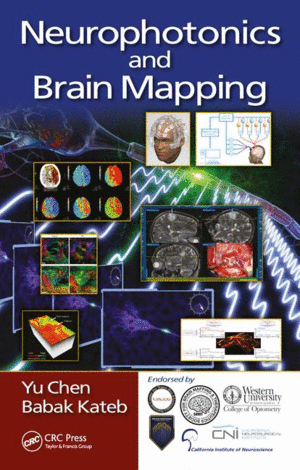
Understanding how the brain works and developing effective therapeutics are important in advancing neuroscience and improving clinical patient care. This book covers state-of-the-art research and development in optical technologies and applications for brain mapping and therapeutics. It provides a comprehensive overview of various methods developed using light, both microscopic and macroscopic techniques. Recent developments in minimally-invasive endoscopic imaging of deep brain structure and function, as well as light-based therapy are also reviewed.
Features
• Covers optical methods for imaging, sensing, and manipulating brain structure and function, as well as multiphoton microscopy, functional brain mapping, image-guided neurosurgery, and optogenetics
• Focuses on disease diagnostics and therapeutics in addition to current methodologies
• Structured around literature-based studies
• Discusses optical imaging in the context of neurosciences
Authors
• Dr. Yu Chen is an associate professor at the University of Maryland in College Park, Maryland. He received his bachelor’s degre in physics from Peking University, Beijing, China, in 1997 and his PhD in bioengineering from the University of Pennsylvania, Philadelphia, Pennsylvania, in 2003. His research interests include the following: optical coherence tomography (OCT), laminar optical tomography (LOT), and multiphoton microscopy (MPM), development of novel quantitative optical sensing and imaging devices for clinical translation, and preclinical and clinical applications of optical technologies in imaging brain function, renal physiology, cancer therapy, and tissue engineering. He received the NSF CAREER Award in 2012. Dr. Chen has been an associate editor of Medical Physics and a guest editor of IEEE Journal of Selected Topics on Quantum Electronics and the SPIE journal Neurophotonics. He is a member of IEEE, SPIE, and the Optical Society of America (OSA) and has served as conference program chair and general chair for OSA Conference on Lasers and Electro-Optics (CLEO): Applications and Technologies.
• Babak Kateb, MD, is a neuroscientist with more than 15 years of research experience. His research has been focused on the introduction of advance diagnostics and therapeutics into clinical neuroscience in order to rapidly identify and introduce game-changing technologies to treat neurological disorders such as brain cancer, Alzheimer’s disease, Parkinson’s disease, and brain and spinal disorders. He did his research fellowship at the University of South California (USC) department of neurosurgery and also studied neuroengineering at USC Ming Hsieh Institute.
 -5%
-5%
 -5%
-5%
 -5%
-5%
 -5%
-5%
 -5%
-5%
 -5%
-5%
 -5%
-5%
 -5%
-5%
 -5%
-5%
 -5%
-5%