Descuento:
-5%Antes:
Despues:
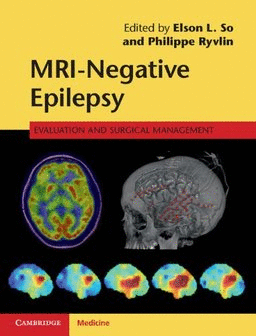
124,93 €Drug-resistant epilepsy with negative MRI is frequently seen in patients considered for epilepsy surgery; however, clinical evaluation and surgical treatment is very complex and challenging. Advanced imaging techniques are needed to detect the location of the epileptogenic zone. In most cases, intracranial EEG recording is required to delineate the region of seizure onset - this carries some risks of major complications. Moreover, the borders between the recorded seizure onset and the location of important brain functions are often indistinct in MRI-negative epilepsy. Overall, the outcome of MRI-negative surgery is less favorable than that of MRI-positive surgery, but it can significantly improve with optimal management. Each chapter critically appraises the role and value of specific diagnostic and treatment techniques to address the challenges of MRI-negative epilepsy surgery. Authors critique evidence and share their expertise on the diagnostic options and surgical approaches that make epilepsy surgery possible and worthwhile in patients with this condition.
- Content clearly organized by diagnostic and treatment options and approaches, and by the type of refractory epilepsy - helps readers learn and evaluate each diagnostic tool or treatment modality, and recognize the most appropriate ones for their own clinical or research settings
- State-of-the-art discussion and critical assessment of each diagnostic or treatment technique - permits readers to compare the strengths and limitations of each technique, and researchers to recognize areas that need further investigations
- Case discussions demonstrating the usefulness of specific diagnostic tools and treatment techniques - enhances readers' appreciation of how the tools and techniques are clinically applied, with the intended outcomes demonstrated.
ABOUT THE AUTHORS
- Elson L. So, Department of Neurology, Mayo Clinic, Rochester, Minnesota. Professor of Neurology, Epilepsy and EEG, Mayo Clinic College of Medicine, Rochester, Minnesota, USA.
- Philippe Ryvlin, Department of Neurology, University of Lyon Medical Center. Head of the Department of Functional Neurology and Epileptology, Neurological Hospital, Hospices Civils de Lyon, Lyon, France.
Contents
1. Scope and implications of MRI-negative refractory focal epilepsy 1
2. Seizure semiology and scalp EEG in MRI-negative refractory focal epilepsy 6
3. Clinical and advanced techniques for optimizing MRI in refractory focal epilepsy 16
4. PET in MRI-negative refractory focal epilepsy 28
5. Advanced SPECT image processing in MRI-negative refractory focal epilepsy 38
6. MEG and magnetic source imaging in MRInegative refractory focal epilepsy 47
7. Electric source imaging in MRI-negative refractory focal epilepsy 56
8. Functional MRI in MRI-negative refractory focal epilepsy 68
9. Multimodality image coregistration for MRI-negative epilepsy surgery 80
10. Subdural electrode implantation and recording in MRI-negative epilepsy surgery 90
11. Depth electrode and stereoelectroencephalography in MRI-negative epilepsy 112
12. Ultraslow and high-frequency recordings in MRI-negative refractory focal epilepsy 129
13. Cortical mapping in MRI-negative epilepsy surgery 136
14. Localization and surgery for MRI-negative temporal lobe and temporal-plus epilepsies 153
15. Localization and surgery in MRI-negative frontal lobe epilepsies 168
16. Localization and surgery in MRI-negative posterior cortex epilepsies 184
17. MRI-negative refractory focal epilepsy in childhood 198
18. Surgical approaches and techniques in MRI-negative focal epilepsy 206
19. Histopathology findings in MRI-negative focal epilepsy 214
20. Neuropsychological issues in MRI-negative focal epilepsy surgery: evaluation and outcomes 223
21. Conclusion 237
Index 240
 -5%
-5%
 -5%
-5%
 -5%
-5%
 -5%
-5%
 -5%
-5%
 -5%
-5%
 -5%
-5%
 -5%
-5%
 -5%
-5%
 -5%
-5%