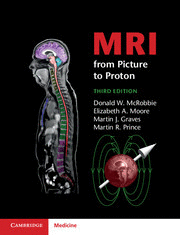
MCROBBIE, D.; MOORE, E.; GRAVES, M.
Descuento:
-5%Antes:
Despues:
71,25 €Glossary
1. MR: what's the attraction?
• Part A. The Basic Stuff:
2. Early daze: your first week in MR
3. Seeing is believing: introduction to image contrast
4. Lost in the pulse sequence jungle?
5. The devil's in the detail: pixels, matrices and slices
6. What you set is what you get: basic image optimisation
7. Improving your image: how to avoid artefacts
8. Spaced out: spatial encoding
9. Getting in tune: resonance and relaxation
10. Let's talk technical: MR equipment
11. Ghosts in the machine: quality control
• Part B. The Specialist Stuff:
12. Acronyms anonymous I: spin echo
13. Acronyms anonymous II: gradient echo
14. The parallel universe: parallel imaging and novel acquisition techniques
15. Go with the flow: MR angiography
16. A heart-to-heart discussion: cardiac MRI
17. It's not just squiggles: in vivo spectroscopy
18. To BOLDly go: fMRI, perfusion and diffusion
19. Making it count: quantitative MRI
20. But is it safe? Bio-effects
21. Where are we going now?
Appendix: maths revision
Index.
MR is a powerful modality. At its most advanced, it can be used not just to image anatomy and pathology, but to investigate organ function, to probe in vivo chemistry, and even to visualise the brain thinking. However, clinicians, technologists and scientists struggle with the study of the subject. The result is sometimes an obscurity of understanding, or a dilution of scientific truth, resulting in misconceptions. This is why MRI from Picture to Proton has achieved its reputation for practical clarity. MR is introduced as a tool, with coverage starting from the images, equipment and scanning protocols and traced back towards the underlying physics theory. With new content on quantitative MRI, MR safety, multi-band excitation, Dixon imaging, MR elastography and advanced pulse sequences, and with additional supportive materials available on the book's website, this new edition is completely revised and updated to reflect the best use of modern MR technology.
Features
• Includes break-out boxes explaining the clinical context
• Provides guidance and ideas for imaging experiments to try
• Offers sections with advanced content for extending your study
• Additional supportive materials are available online
Authors
• Donald W. McRobbie, South Australian Medical Imaging, Adelaide, Australia
Donald W. McRobbie is Chief Medical Physicist for South Australian Medical Imaging, Adelaide, Australia.
• Elizabeth A. Moore, Philips Research Laboratories, The Netherlands
Elizabeth A. Moore manages the Advanced Solutions Department at Philips Healthcare in Eindhoven, The Netherlands.
• Martin J. Graves, Cambridge University Hospitals, Cambridge UK
Martin J. Graves is Consultant Clinical Scientist in the Department of Radiology at Cambridge University Hospitals, Cambridge.
 -5%
-5%
 -5%
-5%
 -5%
-5%
 -5%
-5%
 -5%
-5%
 -5%
-5%
 -5%
-5%
 -5%
-5%
 -5%
-5%
 -5%
-5%