Descuento:
-5%Antes:
Despues:
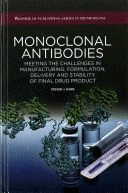
146,30 €1. Introduction
• Pharmaceutical development
• Development of the API
• mAbs as protein therapeutics
• Brief review of mAb structure
2. Analytical tools used in the formulation and assessment of stability of monoclonal antibodies (mAbs)
• Analytical methods for evaluation of monoclonal antibody stability
3. Stability of monoclonal antibodies (mAbs)
• Degradation routes in monoclonal antibodies
• Chemical degradation
• Mechanisms of oxidation
• Nonenzymatic peptide fragmentation
• Nonreducible cross-linking in mAbs
• Physical degradation
• Exposure to air/water interfaces due to agitation
• Use of large-scale pumps in DP unit operations
• Filtration
• Filling
• Adsorption to surfaces
4. Formulation of proteins and monoclonal antibodies (mAbs)
• Formulation of monoclonal antibodies
• Buffers for pH control
• Ionic strength and tonicity modifiers
• Surfactants and surface-active agents
• Antioxidants
• Protein Stabilizers
5. Challenges in the intravenous (IV) administration of monoclonal antibodies (mAbs)
• Extractables and leachables from IV bags and impact on protein/mAb stability
6. Challenges in the subcutaneous (SC) administration of monoclonal antibodies (mAbs)
• The challenge of formulating at high concentration
• Impact on delivery due to high viscosity at high mAb concentrations
• Impact on manufacturing of high-concentration SC formulations due to high viscosity
• Bioavailability of a high-concentration mAb formulation for SC delivery
• Development of analytical tools for high-concentration formulation development
7. Strategies to deal with challenges of developing high-concentration subcutaneous (SC) formulations for monoclonal antibodies (mAbs)
• Using existing manufacturing technologies through redesign of equipment or modification of process variables to produce high-concentration formulations
• Development of alternative processes/formulations for manufacturing of high-concentration dosage forms
• Using formulation excipients to reduce viscosity
8. Development of delivery device technology to deal with the challenges of highly viscous mAb formulations at high concentration
• Using delivery devices to deliver large volume mAb formulations by the subcutaneous route
• Delivery of viscous solutions using a prefilled syringe
• The technical challenges for device and formulation development
• Primary container/closure systems for devices to be used with mAbs
• Silicone oil interactions with proteins and mAbs in prefilled syringes
• Impact of leachables from prefilled syringe components
• Potential interactions with stainless steel needles
• Potential problems with tungsten in prefilled syringes
• Filling of highly concentrated mAbs into prefilled syringes
9. The molecular basis of high viscosity of monoclonal antibodies (mAbs) at high concentration
• What is viscosity?
• How is viscosity measured experimentally?
• Other methods for determination of viscosity
• The dependence of viscosity on attractive protein–protein interactions
• Specific interactions in mAb1 that result in increase of viscosity
• Impact of net charge versus localized surface charge distribution on protein–protein interactions and viscosity as a function of mAb concentration
• Linking amino acid sequence to self-association and viscoelastic behavior of mAb1 and mAb2
• Coarse-grained molecular dynamics computations
10. The future of monoclonal antibodies (mAbs) as therapeutics and concluding remarks
• Index
• Discusses the challenges to develop MAbs for intravenous (IV) and subcutaneous delivery (SC)
• Presents strategies to meet the challenges in development of MAbs for SC and IV administration
• Discusses the use of biophysical analytical tools coupled with MAb engineering to understand what governs MAb properties at high concentration
Author
Steven Shire , Adjunct faculty member, University of Southern California School of Pharmacy and University of Connecticut School of Pharmaceutical Sciences, USA
 -5%
-5%
 -5%
-5%
 -5%
-5%
 -5%
-5%
 -5%
-5%
 -5%
-5%
 -5%
-5%
 -5%
-5%
 -5%
-5%
 -5%
-5%