Descuento:
-5%Antes:
Despues:
59,85 €1. Introduction
2. Exponential growth with appendix on Taylor's theorem
3. Introduction to differential equations
4. Stability in a one component system
5. Systems of first order differential equations
6. Phase plane analysis
7. Introduction to vectors
8. Equilibrium in two component, linear systems
9. Stability in non-linear systems
10. Non-linear stability again
11. Matrix notation
12. Remarks about Australian predators
13. Introduction to advection
14. Diffusion equations
15. Two key properties of the advection and diffusion equations
16. The no trawling zone
17. Separation of variables
18. The diffusion equation and pattern formation
19. Stability criteria
20. Summary of advection and diffusion
21. Traveling waves
22. Traveling wave velocities
23. Periodic solutions
24. Fast and slow
25. Estimating elapsed time
26. Switches
27. Testing for periodicity
28. Causes of chaos
Extra exercises and solutions
Index.
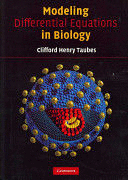
Based on a very successful one-semester course taught at Harvard, this text teaches students in the life sciences how to use differential equations to help their research. It needs only a semester's background in calculus. Ideas from linear algebra and partial differential equations that are most useful to the life sciences are introduced as needed, and in the context of life science applications, are drawn from real, published papers. It also teaches students how to recognize when differential equations can help focus research. A course taught with this book can replace the standard course in multivariable calculus that is more usually suited to engineers and physicists.
Features
• Brought alive by reprints of recent research summary articles from Science and Nature illustrating the mathematics and demonstrating to students how the mathematics in the text is used by working biologists
• Commentary for each reprinted article summarizes the underlying biological issues so neither students nor instructors need prior knowledge, and shows where and how the mathematics is used
• Provides students with the mathematics that is commonly used by biologists and life scientists as opposed to the mathematics of physicists and engineers commonly found in other texts
 -5%
-5%
 -5%
-5%
 -5%
-5%
 -5%
-5%
 -5%
-5%
 -5%
-5%
 -5%
-5%
 -5%
-5%
 -5%
-5%
 -5%
-5%