Descuento:
-5%Antes:
Despues:
141,28 € Foreword
Preface
Abbreviations
Chapter 1: General Aspects of Cancer Chemotherapy
• Abstract
• 1. Introduction: Some General Comments About Cancer
• 2 Tumorigenesis and Oncogenes: Pharmacogenomics
• 3 Early Diagnosis of Cancer and Its Therapeutic Relevance
• 4 A Brief History of Cancer Chemotherapy
• 5 General Comments About Anticancer Drug Discovery
• 6 Combination Therapy and Personalized Anticancer Treatments
• 7 Natural Products in Cancer Chemotherapy
• 8 A Brief Comment About Cancer Nanotechnology
• 9 Summary of FDA-Approved Anticancer Drugs
Chapter 2: Antimetabolites That Interfere with Nucleic Acid Biosynthesis
• Abstract
• 1 Introduction
• 2 Inhibitors of the Biosynthesis of Uridylic Acid
• 3 Inhibitors of Ribonucleotide Reductase
• 4 Inhibitors of the Biosynthesis of Thymidilic Acid
• 5 Inhibitors of Dihydrofolate Reductase
• 6 Inhibitors of the De Novo Purine Biosynthesis Pathway
• 7 Inhibitors of Adenosine Deaminase
• 8 Inhibitors of Late Stages in DNA Synthesis
• 9 Antimetabolite Enzymes
Chapter 3: Anticancer Drugs That Modulate Hormone Action
• Abstract
• 1 Introduction
• 2 Estrogens and Their Involvement in Carcinogenesis
• 3 Antiestrogens as Antitumor Drugs
• 4 Aromatase Inhibitors
• 5 Steroid Sulfatase Inhibitors
• 6 Androgen-Related Antitumor Agents
• 7 Regulation of Gonadotropin-Releasing Hormone: Control of the Hypothalamic–Pituitary–Gonadal axis
• 8 Miscellaneous Steroid Hormone-Related Anticancer Therapy
• 9 Compounds Acting on Other Proteins of the Nuclear Receptor Superfamily: Retinoids
• 10 PPAR Ligands as Antitumor Agents
• 11 Somatostatin Analogs in Neuroendocrine Tumors
Chapter 4: Anticancer Drugs Acting via Radical Species: Radiotherapy and Photodynamic Therapy of Cancer
• Abstract
• 1 Introduction: Radicals and Other Reactive Oxygen Species
• 2 Biological Effects of Reactive Oxygen Species
• 3 Anthracyclines and Their Analogs
• 4 Mitoxantrone and Related Quinones
• 5 Actinomycin D
• 6 Chartreusin, Elsamicin A, and Related Compounds
• 7 Bleomycins
• 8 Enediyne Antibiotics
• 9 Tirapazamine
• 10 Penclomedine
• 11 Radiotherapy and Radiosensitizers
• 12 Photodynamic Therapy of Cancer
Chapter 5: DNA Alkylating Agents
• Abstract
• 1 Introduction
• 2 Nitrogen Mustards
• 3 Aziridines (Ethyleneimines)
• 4 Epoxides
• 5 Methanesulfonates
• 6 Nitrosoureas
• 7 Triazenes
• 8 Methylhydrazines
• 9 1,3,5-Triazines: Hexamethylmelamine and Trimelamol
• 10 Transition Metal Species
• 11 Miscellaneous Alkylating and Acylating Antitumor Agents
Chapter 6: Anticancer Drugs That Interact with the DNA Minor Groove
• Abstract
• 1 Introduction
• 2 Netropsin, Distamycin, and Related Compounds
• 3 Mitomycins
• 4 Tetrahydroisoquinoline Alkaloids
• 5 Cyclopropylindole Alkylating Agents
• 6 Irofulven
• 7 Pyrrolo[1,4]benzodiazepines
Chapter 7: Other Anticancer Drugs Targeting DNA and DNA-Associated Enzymes
• Abstract
• 1 DNA Intercalation and Its Consequences
• 2 Monofunctional Intercalating Agents
• 3 Bifunctional Intercalating Agents
• 4 Indirect DNA Damage by DNA Topoisomerase Inhibitors
• 5 Specific Topoisomerase I Inhibitors
• 6 Topoisomerase II Poisons
• 7 Topoisomerase II Catalytic Inhibitors
• 8 Telomerase Inhibitors and Other Anticancer Approaches Targeting TelomerEs
• 9 DNA Repair Inhibitors
Chapter 8: Epigenetic Therapy of Cancer
• Abstract
• 1 Introduction
• 2 Inhibitors of DNA Methylation: Reactivation of Silenced Genes
• 3 Inhibitors of Histone and Other Protein Deacetylases
• 4 Regulators of Histone Methylation
Chapter 9: Anticancer Drugs Targeting Tubulin and Microtubules
• Abstract
• 1 Introduction
• 2 Drugs That Inhibit Microtubule Polymerization
• 3 Microtubule-Stabilizing Agents: Compounds Binding at the Taxane Site
• 4 Miscellaneous Anticancer Drugs Acting on Novel Sites of Tubuline
• 5 Antivascular Effects of Microtubule-Targeted Agents
• 6 Mitotic Kinesin Inhibitors
Chapter 10: Drugs That Inhibit Signaling Pathways for Tumor Cell Growth and Proliferation: Kinase Inhibitors
• Abstract
• 1 Introduction
• 2 Oncogenes and Signal Transduction
• 3 The Role of Protein Kinases in Cancer: Signaling Pathways Related to Kinases
• 4 Inhibitors of Tyrosine Kinases
• 5 Inhibitors of Serine–Threonine Kinases
• 6 Inhibitors of the Ras/Raf/MEK Signaling Pathway
• 7 Transforming Growth Factor-ß–Smad Signaling
• 8 Glucose Metabolism and Cancer: Inhibitors of Kinases Involved in Anaerobic Glycolysis
Chapter 11: Other Nonbiological Approaches to Targeted Cancer Chemotherapy
• Abstract
• 1 Introduction
• 2 Proteolytic Enzymes as Anticancer Targets
• 3 Heparanase Inhibitors
• 4 Integrin Antagonists and Inhibitors of Chemokine Receptors
• 5 Endogenous Inhibitors of Angiogenesis
• 6 Miscellaneous Antiangiogenic Compounds
• 7 Drugs Targeting Cancer Stem Cells
• 8 Inhibitors of Oncogenic Protein–Protein Interactions
• 9 Anticancer Agents Targeted at the Lysosomes
Chapter 12: Biological Therapy of Cancer
• Abstract
• 1 Introduction
• 2 Monoclonal Antibodies against Cancer Cells
• 3 Cancer Immunotherapy: General Aspects
• 4 Cancer Vaccines
• 5 Gene Therapy
• 6 Antisense Oligonucleotides in Cancer Treatment
• 7 Bacteria and Bacterial Toxins in Cancer Therapy
Chapter 13: Drug Targeting in Anticancer Chemotherapy
• Abstract
• 1 Introduction
• 2 Small-Molecule Prodrugs for Anticancer Drug Targeting
• 3 Therapeutic Nanoparticles for Drug Delivery in Cancer: General Aspects
• 4 Polymer Conjugates: Macromolecular Small-Drug Carrier Systems
• 5 Polymer-Directed Enzyme Prodrug Therapy Approaches
• 6 Folate Receptor-Targeted Chemotherapy
• 7 Liposomes and Other Nanoparticles in Anticancer Drug Targeting
Chapter 14: Drugs That Modulate Resistance to Antitumor Agents
• Abstract
• 1 Introduction
• 2 ABC Efflux Pumps in Anticancer Drug Resistance
• 3 Glutathione and Glutathione S-Transferase in Anticancer Drug Resistance
• 4 Chemosensitizers Targeting DNA Repair Systems
• 5 Antitumor Drug Resistance Related to Cellular Adhesion Molecules
• 6 Antitumor Drug Resistance Related to the Extracellular pH: Tumor-Associated Carbonic Anhydrase as an Anticancer Target
• 7 The Role of the SPARC Protein in Drug Resistance
• 8 Radioresistance and Tumor Radiosensitization
• 9 Induced Tumor Chemoresistance
Chapter 15: Cancer Chemoprevention
• Abstract
• 1 Introduction
• 2 Cancer Biomarkers, Molecular Medicine, and Individualized Treatments
• 3 Cancer Chemoprevention
• 4 Chemopreventive Agents
• 5 Nutritional Supplements
• 6 Ligands for Nuclear Receptors in Cancer Chemoprevention
Index
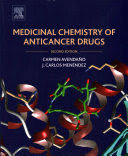
Antitumour chemotherapy is nowadays a very active field of research, and a huge amount of information on the topic is generated every year. Although many books are available that deal with clinical aspects of cancer chemotherapy, this book addresses the need for an updated treatment from the point of view of medicinal chemistry and drug design. Cytotoxic chemotherapy is gradually being supplemented by a new generation of drugs that recognize specific targets on the surface or inside cancer cells. These therapies are in their infancy, but they hold promise of more effective therapies with fewer side effects. Resistance to antitumour drugs is another important but normally neglected field. The focus of Medicinal Chemistry of Anticancer Drugs is on the mechanism of action of antitumour drugs from the molecular point of view and on the relationship between chemical structure and chemical and biochemical reactivity of antitumour agents, aiming at the rationalization of the action of this type of drugs, which would allow the design of new active structures.
Features:
• Presents information in a clear and concise way using a large number of figures
• Historical background provides insights on how the process of drug discovery in the anticancer field has evolved
• Extensive references to primary literature
Authors
• Carmen Avendano, Department of Organic Chemistry, Farmaceutica, Facultad de Farmacia, Madrid, Spain.
• J. Carlos Menendez, Department of Organic Chemistry, Farmaceutica, Facultad de Farmacia, Madrid, Spain
 -5%
-5%
 -5%
-5%
 -5%
-5%
 -5%
-5%
 -5%
-5%
 -5%
-5%
 -5%
-5%
 -5%
-5%
 -5%
-5%
 -5%
-5%