Descuento:
-5%Antes:
Despues:
89,91 €PART I. Foundations
1: The Nature of Theory
2: The Logic of Inference
PART II. Macroecology
3: Scaling Metrics and Macroecology
4: Overview of Macroecological Models and Theories
PART III. The Maximum Entropy Principle
5: Entropy, Information, and the Concept of Maximum Entropy
6: MaxEnt at work
PART IV. Macroecology and MaxEnt
7: The Maximum Entropy Theory of Ecology (METE)
8: Testing METE
PART V. A Wider Perspective
9: Applications to Conservation
10: Connections to other theories
11: Future Directions
Epilogue: Is a Comprehensive Unified Theory of Ecology possible? What might it look like?
Appendix A. Access to plant census data from a serpentine grassland
Appendix B. A fractal model
Appendix C. Predicting the SAR: An alternative approach
References
Index
•Integrates ecology and maximum entropy to provide a comprehensive, predictive, and parsimonious theory that describes the major observed patterns in macroecology
•The Maximum Entropy Theory of Ecology (METE) is placed in a wider context with other theories including Brown's Metabolic Theory of Ecology and Hubbell's Neutral Theory of Ecology
•Mathematical equations are clearly explained with boxed derivations, and exercises provided at the end of each chapter
•Ideal graduate seminar course material
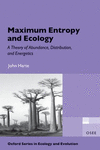
This pioneering graduate textbook provides readers with the concepts and practical tools required to understand the maximum entropy principle, and apply it to an understanding of ecological patterns. Rather than building and combining mechanistic models of ecosystems, the approach is grounded in information theory and the logic of inference. Paralleling the derivation of thermodynamics from the maximum entropy principle, the state variable theory of ecology developed in this book predicts realistic forms for all metrics of ecology that describe patterns in the distribution, abundance, and energetics of species over multiple spatial scales, a wide range of habitats, and diverse taxonomic groups.
The first part of the book is foundational, discussing the nature of theory, the relationship of ecology to other sciences, and the concept of the logic of inference. Subsequent sections present the fundamentals of macroecology and of maximum information entropy, starting from first principles. The core of the book integrates these fundamental principles, leading to the derivation and testing of the predictions of the maximum entropy theory of ecology (METE). A final section broadens the book's perspective by showing how METE can help clarify several major issues in conservation biology, placing it in context with other theories and highlighting avenues for future research.
Readership: Suitable for graduate students and researchers in ecology, biogeography, and biodiversity. It will also be of interest and value to physicists, engineers, and information scientists seeking an entry point into the biological sciences.
 -5%
-5%
 -5%
-5%
 -5%
-5%
 -5%
-5%
 -5%
-5%
 -5%
-5%
 -5%
-5%
 -5%
-5%
 -5%
-5%
 -5%
-5%