Descuento:
-5%Antes:
Despues:
177,84 €1. The Cornea, Anatomy and Function
2. Processing Corneas for Grafting
3. Corneal Storage, Hypothermia, and Organ Culture
4. Various Approaches to the Microscopic Assessment of the Cornea, Visualization and Image Analysis of the Corneal Endothelium
5. Light and Specular Microscopy Assessment of the Cornea for Grafting
6. Atlas of Light and Specular Microscopy of the Cornea
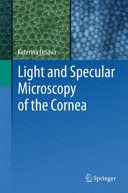
The atlas of the Light and Specular Microscopy of the Cornea, particularly of the corneal endothelium presents photographs of healthy and pathological corneas, as well as corneas prepared for grafting. Photographs are taken from donor or patient’s corneas. The first part section of the atlas shows healthy corneas and its particular layers: the epithelium (superficial and basal cells, subepithelial nerve plexus), stroma and keratocytes, and the endothelium. Blood vessels or palisades of Vogt in limbus are shown as well. The second part section that shows corneas processed for grafting is focused focuses on the endothelial layer. Main causes of exclusion of corneas from grafting, such as the presence of dead cells, polymeghatism, pleomorphism, cornea guttata or stromal scars have been shown. The third part section of the atlas shows corneas before and after storage in tissue cultures or hypothermic conditions with the aim to assess its suitability of for tissue for grafting. The last final section contains photographs of pathological corneal explants
Features
• The first published atlas of the cornea in light and specular microscopy which helps to assess and decide upon the suitability of corneas for grafting
• Illustrative photographs attached to an educative text to discern healthy and pathological corneas
• Photographs include corneas stored in tissue culture, hypothermic conditions, as well as pathological explants which increases both the appeal and the interest of the atlas to a wide audience
Author
Katerina Jirsova Laboratory of the Biology and Pathology of the EyeInstitute of Inherited Metabolic DisordersCharles University First Faculty of Medicine, Ke Karlovu 2, 128 08, Prague 2, Czech Republickaterina.jirsova@lf1.cuni.cz
 -5%
-5%
 -5%
-5%
 -5%
-5%
 -5%
-5%
 -5%
-5%
 -5%
-5%
 -5%
-5%
 -5%
-5%
 -5%
-5%
 -5%
-5%