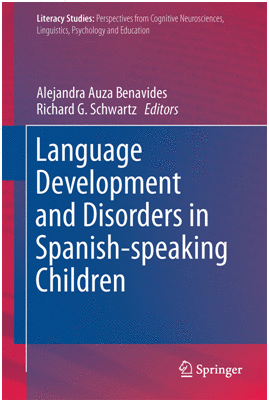
AUZA BENAVIDES, A.; SCHWARTZ, R.G.
Descuento:
-5%Antes:
Despues:
98,80 €1. Typical Language Development of Monolingual Spanish-Speaking Children
2. Language Development in Bilingual Spanish-Catalan Children with and Without Specific Language Impairment: A Longitudinal Perspective
3. Bilingual and Monolingual Children’s Patterns of Syntactic Variation: Variable Clitic Placement in Spanish
4. Executive Functions and Language Development in Pre-Term and Full-Term Children
5. Processing Speed of Infants with High and Low Communicative Skills
6. Relevance of Family Psychosocial Environment in the Language Development of Mexican Children
7. Language Delay and Amount of Exposure to the Language: Two (Un)Related Phenomena in Early Spanish-Basque Bilingualism
8. Neurocognitive and Psycholinguistic Profile of Specific Language Impairment: A Research Study on Comorbidity of SLI With/Without Reading Disabilities
9. Connections Among Language Knowledge, Language Processing, and Nonlinguistic Cognitive Processing in Bilingual Children with Language Impairment
10. Sentence Repetition in Typical and Atypical Spanish-Speaking Preschoolers Who Are English Language Learners
11. The Role of Verb Semantic Representation in Sentence Processing in Children with SLI
12. Self-Repair Timing of Lexical Problem Sources: A Window into Primary Language Impairment Online Processing
13. Narrative Comprehension and Language Skills in Chilean Children with Specific Language Impairment
14. Working Memory and Morphosyntax in Children with Specific (Primary) Language Impairment
15. Morphological Profile of Williams Syndrome: Typical or Atypical?
16. Language Skills in Down Syndrome
17. Vocabulary and Cognitive Flexibility in People with Down Syndrome
Prominent researchers from the US, Mexico, Chile, Colombia and Spain contribute experimental reports on language development of children who are acquiring Spanish. The chapters cover a wide range of dimensions in acquisition: comprehension and production; monolingualism and bilingualism; typical development, children who are at risk and children with language disorders, phonology, semantics, and morphosyntax. These studies will inform linguistic theory development in clinical linguistics as well as offer insights on how language works in relation to cognitive functions that are associated with when children understand or use language. The unique data from child language offer perspectives that cannot be drawn from adult language. The first part is dedicated to the acquisition of Spanish as a first or second language by typically-developing children, the second part offers studies on children who are at risk of language delays, and the third part focuses on children with specific language impairment, disorders and syndromes.
Features
• Offers original empirical studies in children's acquisition of Spanish as a first or second languageCovers information from children who develop typically, children at risk, and children with language disorders
• Brings together contributions from different theoretical and clinical perspectives
 -5%
-5%
 -5%
-5%
 -5%
-5%
 -5%
-5%
 -5%
-5%
 -5%
-5%
 -5%
-5%
 -5%
-5%
 -5%
-5%
 -5%
-5%