Descuento:
-5%Antes:
Despues:
44,65 ۥ Part I. Holonomic approximation 524
Jets and holonomy 726
Thom transversality theorem 1534
Holonomic approximation 2140
Applications 3756
• Part II. Differential relations and Gromov’s h-principle 5170
Differential relations 5372
Homotopy principle 5978
Open Diff ??-invariant differential relations 6584
Applications to closed manifolds 6988
• Part III. The homotopy principle in symplectic geometry 7392
Symplectic and contact basics 7594
Symplectic and contact structures on open manifolds 99118
Symplectic and contact structures on closed manifolds 105124
Embeddings into symplectic and contact manifolds 111130
Microflexibility and holonomic R-approximation 129148
First applications of microflexibility 135154
Microflexible ??-invariant differential relations 139158
Further applications to symplectic geometry 143162
• Part IV. Convex integration 151170
One-dimensional convex integration 153172
Homotopy principle for ample differential relations 167186
Directed immersions and embeddings 173192
First order linear differential operators 179198
Nash-Kuiper theorem 189208
Bibliography
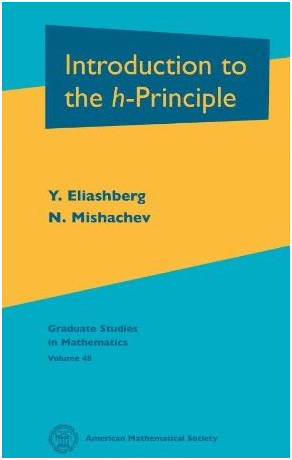
In differential geometry and topology one often deals with systems of partial differential equations, as well as partial differential inequalities, that have infinitely many solutions whatever boundary conditions are imposed. It was discovered in the fifties that the solvability of differential relations (i.e. equations and inequalities) of this kind can often be reduced to a problem of a purely homotopy-theoretic nature. One says in this case that the corresponding differential relation satisfies the $h$-principle. Two famous examples of the $h$-principle, the Nash-Kuiper $C^1$-isometric embedding theory in Riemannian geometry and the Smale-Hirsch immersion theory in differential topology, were later transformed by Gromov into powerful general methods for establishing the $h$-principle.The authors cover two main methods for proving the $h$-principle: holonomic approximation and convex integration. The reader will find that, with a few notable exceptions, most instances of the $h$-principle can be treated by the methods considered here. A special emphasis in the book is made on applications to symplectic and contact geometry. Gromov's famous book ""Partial Differential Relations"", which is devoted to the same subject, is an encyclopedia of the $h$-principle, written for experts, while the present book is the first broadly accessible exposition of the theory and its applications. The book would be an excellent text for a graduate course on geometric methods for solving partial differential equations and inequalities. Geometers, topologists and analysts will also find much value in this very readable exposition of an important and remarkable topic.
 -5%
-5%
 -5%
-5%
 -5%
-5%
 -5%
-5%
 -5%
-5%
 -5%
-5%
 -5%
-5%
 -5%
-5%
 -5%
-5%
 -5%
-5%