Descuento:
-5%Antes:
Despues:
111,44 €PREFACE ix
ACKNOWLEDGEMENTS xi
NOTICES xiii
ABOUT THE COMPANION WEBSITE xv
• PART ONE BASIC CONCEPTS 1
1 THINKING ABOUT CHANCE 3
1.1 Properties of Probability / 3
1.2 Combinations of Events / 7
1.2.1 Intersections / 8
1.2.2 Unions / 13
1.3 Bayes’ Theorem / 15
2 DESCRIBING DISTRIBUTIONS 18
2.1 Types of Data / 19
2.2 Describing Distributions Graphically / 19
2.2.1 Graphing Discrete Data / 20
2.2.2 Graphing Continuous Data / 22
2.3 Describing Distributions Mathematically / 26
2.3.1 Parameter of Location / 27
2.3.2 Parameter of Dispersion / 31
2.4 Taking Chance into Account / 38
2.4.1 Standard Normal Distribution / 39
3 EXAMINING SAMPLES 49
3.1 Nature of Samples / 50
3.2 Estimation / 51
3.2.1 Point Estimates / 51
3.2.2 The Sampling Distribution / 56
3.2.3 Interval Estimates / 60
3.3 Hypothesis Testing / 64
3.3.1 Relationship between Interval Estimation and Hypothesis Testing / 72
• PART TWO UNIVARIABLE ANALYSES 75
4 UNIVARIABLE ANALYSIS OF A CONTINUOUS DEPENDENT VARIABLE 79
4.1 Student’s t-Distribution / 81
4.2 Interval Estimation / 84
4.3 Hypothesis Testing / 86
5 UNIVARIABLE ANALYSIS OF AN ORDINAL DEPENDENT VARIABLE 90
5.1 Nonparametric Methods / 90
5.2 Estimation / 94
5.3 Wilcoxon Signed-Rank Test / 95
5.4 Statistical Power of Nonparametric Tests / 97
6 UNIVARIABLE ANALYSIS OF A NOMINAL DEPENDENT VARIABLE 99
6.1 Distribution of Nominal Data / 100
6.2 Point Estimates / 101
6.2.1 Proportions / 101
6.2.2 Rates / 104
6.3 Sampling Distributions / 108
6.3.1 Binomial Distribution / 108
6.3.2 Poisson Distribution / 112
6.4 Interval Estimation / 114
6.5 Hypothesis Testing / 117
• PART THREE BIVARIABLE ANALYSES 121
7 BIVARIABLE ANALYSIS OF A CONTINUOUS DEPENDENT VARIABLE 123
7.1 Continuous Independent Variable / 123
7.1.1 Regression Analysis / 125
7.1.2 Correlation Analysis / 149
7.2 Ordinal Independent Variable / 165
7.3 Nominal Independent Variable / 166
7.3.1 Estimating the Difference between the Groups / 166
7.3.2 Taking Chance into Account / 167
8 BIVARIABLE ANALYSIS OF AN ORDINAL DEPENDENT VARIABLE 175
8.1 Ordinal Independent Variable / 176
8.2 Nominal Independent Variable / 184
9 BIVARIABLE ANALYSIS OF A NOMINAL DEPENDENT VARIABLE 189
9.1 Continuous Independent Variable / 190
9.1.1 Estimation / 191
9.1.2 Hypothesis Testing / 198
9.2 Nominal Independent Variable / 200
9.2.1 Dependent Variable Not Affected by Time: Unpaired Design / 201
9.2.2 Hypothesis Testing / 208
9.2.3 Dependent Variable Not Affected by Time: Paired Design / 218
9.2.4 Dependent Variable Affected by Time / 223
• PART FOUR MULTIVARIABLE ANALYSES 227
10 MULTIVARIABLE ANALYSIS OF A CONTINUOUS DEPENDENT VARIABLE 229
10.1 Continuous Independent Variables / 230
10.1.1 Multiple Regression Analysis / 231
10.1.2 Multiple Correlation Analysis / 247
10.2 Nominal Independent Variables / 248
10.2.1 Analysis of Variance / 249
10.2.2 Posterior Testing / 258
10.3 Both Continuous and Nominal Independent Variables / 265
10.3.1 Indicator (Dummy) Variables / 266
10.3.2 Interaction Variables / 267
10.3.3 General Linear Model / 273
11 MULTIVARIABLE ANALYSIS OF AN ORDINAL DEPENDENT VARIABLE 281
11.1 Nonparametric Analysis of Variance / 282
11.2 Posterior Testing / 288
12 MULTIVARIABLE ANALYSIS OF A NOMINAL DEPENDENT VARIABLE 293
12.1 Continuous And/or Nominal Independent Variables / 294
12.1.1 Maximum Likelihood Estimation / 294
12.1.2 Logistic Regression Analysis / 297
12.1.3 Cox Regression Analysis / 306
12.2 Nominal Independent Variables / 307
12.2.1 Stratified Analysis / 308
12.2.2 Relationship between Stratified Analysis and Logistic Regression / 318
12.2.3 Life Table Analysis / 322
APPENDIX A: FLOWCHARTS 335
APPENDIX B: STATISTICAL TABLES 341
APPENDIX C: STANDARD DISTRIBUTIONS 377
APPENDIX D: EXCEL PRIMER 380
INDEX 385
A practical and methodological approach to the statistical logic of biostatistics in the field of health research
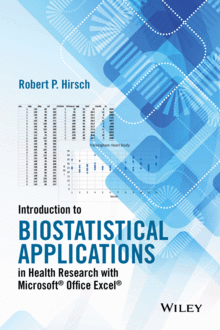
Focusing on a basic understanding of the methods and analyses in health research, Introduction to Biostatistical Applications in Health Research with Microsoft® Office Excel® provides statistical concepts for interpreting results using Excel. The book emphasizes the application of methods and presents the most common methodological procedures in health research, which includes multiple regression, ANOVA, ANCOVA, logistic regression, Cox regression, stratified analysis, life table analysis, and nonparametric parallels.
The book is constructed around a flowchart that outlines the appropriate circumstances for selecting a method to analyze a specific set of data. Beginning with an introduction to the foundational methods of statistical logic before moving on to more complex methods, Introduction to Biostatistical Applications in Health Research with Microsoft® Office Excel® also includes:
• Detailed discussions of how knowledge and skills in health research have been integrated with biostatistical methods
• Numerous examples with clear explanations that use mostly real-world health research data in order to provide a better understanding of the practical applications
• Implements Excel graphic representations throughout to help readers evaluate and analyze individual results
• An appendix with basic information on how to use Excel
• A companion website with additional Excel files, data sets, and homework problems as well as an Instructor’s Solutions Manual
Introduction to Biostatistical Applications in Health Research with Microsoft® Office Excel® is an excellent textbook for upper-undergraduate and graduate-level courses in biostatistics and public health. In addition, the book is an appropriate reference for both health researchers and professionals.
Author Information
• Robert P. Hirsch, PhD, is on the faculty for the Foundation for the Advanced Education in the Sciences within the Graduate School at the National Institutes of Health. He is also a retired Professor of Epidemiology and Biostatistics and Adjunct Professor of Statistics at The George Washington University. Dr. Hirsch is the author of numerous books in the field of health research and practice.
 -5%
-5%
 -5%
-5%
 -5%
-5%
 -5%
-5%
 -5%
-5%
 -5%
-5%
 -5%
-5%
 -5%
-5%
 -5%
-5%
 -5%
-5%
 -5%
-5%
 -5%
-5%