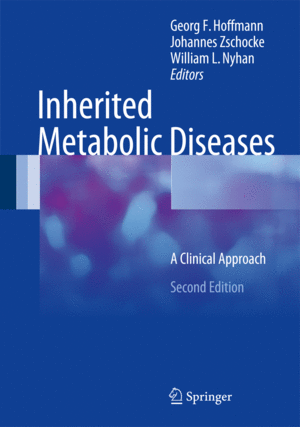
HOFFMANN, G.; ZSCHOCKE, J.; NYHAN, W.
Descuento:
-5%Antes:
Despues:
211,43 €1. Introduction to Inborn Errors of Metabolism: Disorders of Intermediary Metabolism
2. Mitochondriopathies Neurotransmitter Defects
3. Disorders of the Biosynthesis and Breakdown of Complex Molecules. Approach to the Patient: When to Suspect Metabolic Disease
4. Patient Care and Treatment
5. Metabolic Emergencies
6. Anesthesia and Metabolic Disease
7. Principles of Dietary Therapy
8. Principles of Enzyme Replacement Therapy
9. Principles of Gene Therapy. Organ Systems in Metabolic Disease: Cardiovascular Disease
10. Liver Disease
11. Gastrointestinal and General Abdominal Symptoms
12. Kidney Disease and Electrolyte Disturbances
13. Neurological Disease
14. Metabolic Myopathies
15. Psychiatric Disease
16. Eye Disorder
17. Skin and Hair Disorders
18. Bone Disorders
19. Physical Abnormalities in Metabolic Diseases
20. Hematological Disorders
21. Immunological Problems. Investigations for Metabolic Diseases: Newborn Screening
22. Biochemical Studies
23. Enzymes, Metabolic Pathways, Flux Control Analysis and the Enzymology of Specific Groups of Inherited Metabolic Diseases
24. Molecular Investigations (DNA Studies)
25. Pathology / Biopsy
26. Postmortem Investigations
27. Neuroimaging
28. Function Tests
29. Suspected Mitochondrial Disorder. Appendix: Differential Diagnosis of Clinical and Biochemical Phenotypes
30. Reference Books
31. E3 Internet Resources.
This book focuses on clinical presentations that may be caused by inherited metabolic diseases. Its symptom- and system-based approach will help clinicians with and without detailed knowledge of human biochemistry in all specialties to reach a correct diagnosis and institute the optimal treatment program. The book summarizes the central elements of inherited metabolic diseases and describes clearly how to carry out an efficient yet complete diagnostic work-up, thereby guiding the clinician from the presenting symptoms and signs through to effective initial management. After an introduction to the different disorders, the book explains when to consider an inborn metabolic error and which initial tests to order. Core aspects such as structured communication, guidelines, transition, pregnancy, maternal care and how to respond to various medical emergencies are covered. Therapeutic concepts such as dietary treatment are delineated and practical advice provided on the quite different treatment approaches required for individual diseases. An extensive section structured according to organ systems outlines the correct approach in the context of specific symptoms and signs. The value of each of the potential investigations is explained, with precise advice on the interpretation of results. The inclusion of algorithms, tables, lists, and charts facilitates rapid decision making and information retrieval, and the appendices include a helpful guide to differential diagnosis based on clinical and biochemical phenotypes. This new updated edition of Inherited Metabolic Diseases will be an invaluable aid for the busy clinician and an excellent quick reference for metabolic and genetic specialists.
Features
• Provides clear guidance on diagnosis and initial management of patients with metabolic diseases
• Helps physicians to reach correct diagnoses, reducing unnecessary referrals
• Offers a valuable, quick reference for metabolic and genetic specialists
• Contains helpful algorithms and a compendium of differential diagnoses
• Written by renowned experts in the field
Authors
• Georg F. Hoffmann, Dr.med.habil, MD, is Professor and Chairman of the University Childrens Hospital Heidelberg, Head of the Metabolic Center including the Newborn Screening Laboratory as well as Head of the Center for Rare Diseases, Medical Center University of Heidelberg Germany. He has been working in the field of diagnosis and treatment of patients with inherited metabolic diseases for over 30 years with the main emphasis on newborn screening as well as clinical and laboratory research on neurometabolic and intoxication type disorders (neurotransmitter defects, aminoacidopathies, organoacidopathies, and urea cycle disorders).
• Johannes Zschocke, Dr.med.habil, PhD is Professor and Chair of Human Genetics at the Medical University Innsbruck, Austria, and is Director of the Division for Human Genetics and the Center for Medical Genetics Innsbruck. He has longstanding clinical and research experience in inherited metabolic diseases, with special expertise in genetic diagnosis and genotype-phenotype correlations.
• William L. Nyhan, MD, PhD is Distinguished Professor of Pediatrics and Director of the Biochemical Genetics Laboratory at the University of California San Diego. He is the author of 655 publications, including the Atlas of Inherited Metabolic Diseases and is a Board Member of Lesch-Nyhan Syndrome Children’s Research Foundation, 1995 to present.
 -5%
-5%
 -5%
-5%
 -5%
-5%
 -5%
-5%
 -5%
-5%
 -5%
-5%
 -5%
-5%
 -5%
-5%
 -5%
-5%
 -5%
-5%