Descuento:
-5%Antes:
Despues:
212,42 €Foreword
Preface
Acknowledgment
Chapter 1
The Early Diagnosis of Alzheimer's Disease: From Behavioral to Genetic Study
Chapter 2
Environmental Landscape Design for Alzheimer's
Chapter 3
Evaluation of the Relationship between Nutritional Status and Quality of Life among Nursing Home Residents with Alzheimer's Disease
Chapter 4
Early Detection of Dementia: Advances, Challenges, and Future Prospects Sample PDF
Chapter 5
Dementia and Language Bilingualism Helps Ward Off Alzheimer's Disease Sample PDF
Chapter 6
Stimulation Devices for Human Haptic Perception and Their Applications in Cranial Nerve Diseases Sample PDF
Chapter 7
Transfer of Training between Working Memory Task and Attentional Task Sample PDF
Chapter 8
Cognitive and Neural Mechanisms Involved in Interactions between Touch and Emotion Sample PDF
Chapter 9
Effects of Visual Contrast on Inverse Effectiveness in Audiovisual Integration Sample PDF
Chapter 10
The Status of Research into Intention Recognition
Research on Current Situations for Functional Classification of Timing
Chapter 12
MRI-Compatible Haptic Stimuli Delivery Systems for Investigating Neural Substrates of Touch
Chapter 13
The Present Visual Equipment System and Its Application in fMRI
Chapter 14
Humanoid Robots: Future Avatars for Humans through BCI
About the Contributors
Index
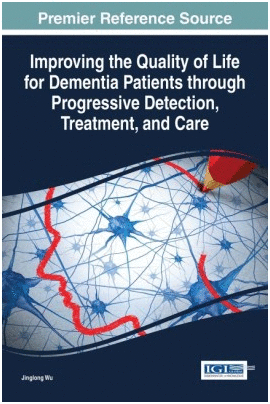
The prominence of dementia within the global aging population has undergone an increase in recent years. To improve the living conditions of patients, researchers must place more emphasis on early detection methods.
Improving the Quality of Life for Dementia Patients through Progressive Detection, Treatment, and Care provides a thorough overview of emerging research on various neuroscience methods for the early diagnosis of dementia and focuses on the improvement of healthcare delivery to patients. Highlighting relevant issues on health information systems, behavioral indicators, and treatment methods, this book is a pivotal reference source for health professionals, neuroscientists, upper-level students, practitioners, and researchers interested in the latest developments within the field of dementia treatment.
Author
Jinglong Wu was born in Jiutai, China, on August 4, 1958. He received the B.S. degree from Jilin Vocational Teachers College, China, the M.S. degree from Kyoto University, Japan, both in electric engineering, in 1984 and 1991, respectively, and the doctorate in electric engineering from Kyoto University, Japan, in 1994. He was an Assistant Professor at Ritsumeikan University, Japan, from April 1994 to March 1997, a Lectuer in Department of Mechanical Engineering, Faculty of Engineering, Yamaguchi University from April 1997 to March 1999. Since April 1999, he is Professor in the Department of Intelligent Mechanical Systems, Faculty of Engineering, Kagawa University. His current research interests are virtual reality, ergonomics, cognitive neuroscience and human science. Dr.Wu received the Best Paper Award of IEEE Joint International Conference on Neural Network in 1993 and the SICE Best Paper Award in 2000. In 2003 he received the Gennai Grand Prize, Ozaki Foundation, Japan.
 -5%
-5%
 -5%
-5%
 -5%
-5%
 -5%
-5%
 -5%
-5%
 -5%
-5%
 -5%
-5%
 -5%
-5%
 -5%
-5%
 -5%
-5%
 -5%
-5%