Descuento:
-5%Antes:
Despues:
71,09 €List of Contributors
Chapter 1. Pharmacological Strategies Using Biologics as Immunomodulatory Agents
• Abstract
• 1.1 Introduction
• 1.2 From Nonspecific to Targeted Immunosuppression
• 1.3 From Immunosuppression to Immune Rebalancing
• 1.4 Conclusions
• Acknowledgments
• References
Part I: Mechanisms of Immune-Related Pathologies and their Current Treatment
Chapter 2. Advance in Therapies for Rheumatoid Arthritis: New Perspectives
• Abstract
• 2.1 Introduction
• 2.2 Rheumatoid Arthritis Management
• 2.3 New Alternatives for the Treatment of RA
• 2.4 Loss of Immune Tolerance as a Factor for RA Development: A Possible Target
• 2.5 Resolution of Inflammation
• 2.6 Challenges
• 2.7 Concluding Remarks
• References
Chapter 3. Immune Based Therapies for Inflammatory Bowel Disease
• Abstract
• 3.1 Introduction
• 3.2 Immune Regulation in IBD
• 3.3 Current Immune Based Therapies in IBD
• 3.4 Immunomodulators
• 3.5 Biological Agents
• 3.6 Next Generation Immune Based Therapies in IBD
• 3.7 Conclusion
• References
Chapter 4. Multiple Sclerosis and Neurodegenerative Diseases
• Abstract
• 4.1 Introduction
• References
Chapter 5. Therapeutic Approaches in Allergic Diseases
• Abstract
• 5.1 General Aspects of Allergic Diseases
• 5.2 Modulation of Allergen-Specific Responses
• 5.3 Targeting Th2 Cytokines: IL-5, IL-4, and IL-13
• 5.4 Targeting IgE and FceRI
• 5.5 Targeting Mast Cells and Eosinophils
• 5.6 Conclusions
• References
Chapter 6. Immunotherapy for Transforming Advanced Cancer into a Chronic Disease: How Far Are We?
• Abstract
• 6.1 Introduction: The Basic Biology of Chronic Diseases
• 6.2 The Evidence of a Transition to Chronicity
• 6.3 The Pharmacologic Consequence: Anticancer Drugs for Long-Term Use
• 6.4 The Expanding Role of Immunotherapy
• 6.5 A Methodological Consequence: The Need of Novel Approaches to Clinical Trial Design and Evaluation
• 6.6 Immune Rebalancing: The Research Agenda for the Age of Chronicity
• References
Part II: Biologics as Immunosuppressive Agents
Chapter 7. Modulation of Macrophage Activation
• Abstract
• 7.1 Introduction
• 7.2 An Overview on Macrophage Polarization/Activation
• 7.3 M1/M2 Skewing: Detrimental and Beneficial Consequences
• 7.4 Mechanisms of Macrophage Activation
• 7.5 Local Conditions and Cell–Cell Interactions: Other Cues in Macrophage Polarization
• 7.6 Therapeutic Applications Based on Modulation of Macrophage Polarization/Activation in the Tumor
• 7.7 Conclusions
• Acknowledgments
• Conflict of Interest
• References
Chapter 8. Modulating Inflammatory Cytokines: IL-1
• Abstract
• 8.1 Introduction
• 8.2 Biologicals Targeting IL-1
• 8.3 Blocking IL-1 in Disease
• 8.4 Conclusions
• References
Chapter 9. Systems Medicine of Autoimmune Diseases: From Understanding Complexity to Precision Treatments
• Abstract
• 9.1 Introduction
• 9.2 From Systems Biology to Systems Medicine
• 9.3 Systems Biology and the Emerging Technologies
• 9.4 Application of Emerging Technologies in Autoimmune Research
• 9.5 From Systems Medicine to Precision Medicine
• References
Chapter 10. The Microbiota and Its Modulation in Immune-Mediated Disorders
• Abstract
• 10.1 Introduction
• 10.2 Development of the Gut Microbiota
• 10.3 Microbiota Effects on Immune Development
• 10.4 Microbiota Modulation
• 10.5 Microbiota Involvement in Prevalence and Progression Immune-Related Disease
• 10.6 Summary and Conclusions
• Acknowledgements
• References
Chapter 11. Natural Products: Immuno-Rebalancing Therapeutic Approaches
• Abstract
• 11.1 Introduction
• 11.2 Modulation of Immune Responses for Disease Prevention and Treatment
• 11.3 Traditional Medicinal Preparations have Immunoactive Properties
• 11.4 Natural Products can Influence and Modify Intersystem Interactions and Infection Resistance
• 11.5 Immunosuppression is not the Abrogation but the Rebalancing of Immune Functions
• 11.6 The Oxidant versus Antioxidant Argument does not Provide Responses but Creates Uncertainty
• 11.7 Neuroprotection/Restoration is Achievable by Natural Products
• 11.8 C-Phycocyanin/Phycocyanobilin Properties, Mechanisms and Prospects
• 11.9 Conclusions
• References
Chapter 12. Nanomedicine
• Abstract
• 12.1 Why Nanomaterials?
• 12.2 Products on the Market or in Development
• 12.3 Suppressing Immunity: Autoimmunity and Other Cases
• 12.4 Activating Immunity: The Future of Vaccines?
• 12.5 Cancer as an Immunological Disease
• 12.6 Allergy
• 12.7 What Are We Really Using?
• 12.8 Rebalancing Exciting New Prospects and Over-Optimistic Hype
• 12.9 Acknowledgements
• References
Index
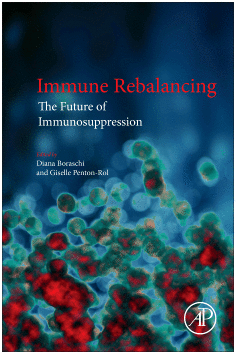
Immune Rebalancing: The Future of Immunosuppression summarizes the most promising perspectives of immunopharmacology, in particular in the area of immunosuppression by considering molecular pathways, personalized medicine, microbiome and nanomedicine. Modulation of immune responses for therapeutic purposes is a particularly relevant area, given the central role of anomalous immunity in diseases. These diseases vary from the most typically immune-related syndromes (autoimmune diseases, allergy and asthma, immunodeficiencies) to those in which altered immunity and inflammation define the pathological outcomes (chronic infections, tumours, chronic inflammatory and degenerative diseases, metabolic disorders, etc.
Features:
• Visits immunosuppression from a modern point of view of signalling mechanisms at the light of the current knowledge of signalling mechanisms and regulatory networks allows the reader to formulate new ideas and concepts on how to use immunosuppression the therapeutic purposes
• Encourages researchers to engage into exploring the field of pharmacological modulation of immune responses in depth, and with the new knowledge and tools available, designs more effective therapeutic strategies to autoimmune and inflammatory diseases, cancer, degenerative diseases and infections
• Examines the link between molecular pathways associated to immune-suppression and the new immunopharmacology approaches
• Provides information on the new strategies for drug development in this field
• Considers the role of microbes in the development of the mammalian immune system and immune responses, which will widen the reader’s strategy for addressing therapeutic immune modulations
Authors
• Diana Boraschi, PhD, Research Director, Institute of Biomedical Technologies, Italian National Research Council, Pisa, Italy.
• Giselle Penton-Rol, Center for Genetic Engineering and Biotechnology (CIGB), Havana, Cuba
 -5%
-5%
 -5%
-5%
 -5%
-5%
 -5%
-5%
 -5%
-5%
 -5%
-5%
 -5%
-5%
 -5%
-5%
 -5%
-5%
 -5%
-5%