Descuento:
-5%Antes:
Despues:
69,15 €1. Introduction
2. Risk and Risk Management
3. Acceptability and Ownership of Risk
4. Standards and Quality Management in Health IT
5. Safety and the Operating Environment
6. Failure of Health IT
7. Availability and Performance of Health IT
8. The Safety Management System
9. The Scope of Clinical Risk Management
10. Evidencing a Competent Team
11. Planning a Clinical Risk Management Project
12. Structuring the Hazard Register
13. Populating the Hazard Register
14. Estimating and Evaluating Clinical Risk
15. Developing Control Strategies
16. Software Testing in Clinical Risk Management
17. Gathering Evidence for the Safety Case
18. Developing the Clinical Safety Case
19. Handling Faults in Live Service
20. Maintaining the Safety Case
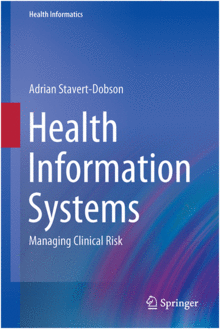
This is a practical book for health and IT professionals who need to ensure that patient safety is prioritized in the design and implementation of clinical information technology.
Healthcare professionals are increasingly reliant on information technology to deliver care and inform their clinical decision making. Health IT provides enormous benefits in efficiency, communication and decision making. However a number of high-profile UK and US studies have concluded that when Health IT is poorly designed or sub-optimally implemented then patient safety can be compromised.
Manufacturers and healthcare organizations are increasingly required to demonstrate that their Health IT solutions are proactively assured. Surprisingly the majority of systems are not subject to regulation so there is little in the way of practical guidance as to how risk management can be achieved. The book fills that gap.
The author, a doctor and IT professional, harnesses his two decades of experience to characterize the hazards that health technology can introduce. Risk can never be eliminated but by drawing on lessons from other safety-critical industries the book systematically sets out how clinical risk can be strategically controlled. The book proposes the employment of a Safety Case to articulate and justify residual risk so that not only is risk proactively managed but it is seen to be managed. These simple techniques drive product quality and allow a technology’s benefits to be realized without compromising patient safety.
Features
• Seamlessly brings together the disciplines of patient safety, health informatics and safety engineering in a simple and comprehensive text
• Offers a practical and systematic method for identifying potential hazards in Health IT systems and presents options for how these risk can be mitigated
• Demonstrates how residual risk can be justified by objectively developing a structured argument and presenting evidence in the form of a balanced safety case
Author
Adrian Stavert-Dobson is a medical doctor, computer programmer and health informatician. He successfully developed his first eHealth solution aged just 18 and went on to study Medicine at the University of Leicester. His passion for technology took him from clinical practice in anesthetics to full-time Hhealth IT working with a number of innovative software suppliers in the UK and abroad.
A strong advocate for patient safety, Adrian has specialized in the management of clinical risk in Health IT systems. Working alongside professional safety engineers he has adapted techniques well-established in other safety critical industries to the healthcare domain.
 -5%
-5%
 -5%
-5%
 -5%
-5%
 -5%
-5%
 -5%
-5%
 -5%
-5%
 -5%
-5%
 -5%
-5%
 -5%
-5%
 -5%
-5%