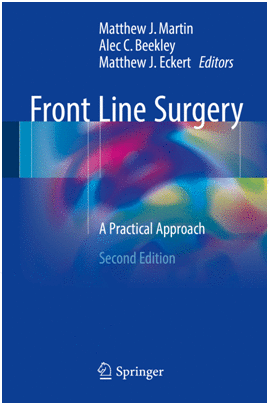
MARTIN, M.; BEEKLEY, A.; ECKERT, M.
Descuento:
-5%Antes:
Despues:
158,07 €1. Tactical Combat Casualty Care
2. Combat Triage and Mass Casualty Management
3. Initial Management Priorities: Beyond ABCDE
4. Damage Control Resuscitation
5. To Operate or Image? (Pulling the Trigger)
6. Ultrasound in Combat Trauma
7. The Bowel: Contamination, Colostomies, and Combat Surgery
8. Liver and Spleen Injury Management in Combat
9. Pancreatic and Duodenal Injuries (Don’t Mess with the…)
10. Operative Management of Renal Injuries
11. Major Abdominal Vascular Trauma
12. To Close or Not to Close: Managing the Open Abdomen
13. Dismounted Complex Blast Injury Management
14. Thoracic Approaches and Incisions
15. Lung Injuries in Combat
16. Diagnosis and Management of Penetrating Cardiac Injury
17. Thoracic Vascular Injuries: Operative Management in “Enemy” Territory
18. Chest Wall and Diaphragm Injury
19. Soft Tissue Wounds and Fasciotomies
20. Extremity Fractures and the Mangled Extremity
21. Traumatic Amputations
22. Peripheral Vascular Injuries
23. The Neck
24. Genitourinary Injuries (Excluding Kidney)
25. Neurosurgery for Dummies
26. Traumatic Brain Injury and Neurocritical Care
27. Spine Injuries
28. Face and Head (Non-ocular) Injury
29. Managing Eye Trauma in the Combat Environment
30. Burn Care in the Deployed Setting
31. The Pediatric Patient in Wartime
32. The Combat Hospital ICU
33. Postoperative Resuscitation
34. TEG/ROTEM-Driven Resuscitation in Trauma
35. Monitoring
36. Ventilator Management: A Practical Approach to Respiratory Failure in Combat Casualties
37. Practical Approach to Combat-Related Infections and Antibiotics
38. Patient Transfer, En Route Care, and Critical Care Air Transport Team (CCATT)
39. The Homefront: Role 4 and 5 Care
40. Active Shooter and Intentional Mass Casualty Events
41. Tactical Emergency Casualty Care (TECC): Principles and Practice
42. Humanitarian and Local National Care
43. Expectant and End-of-Life Care in a Combat Zone
44. Trauma System Development and the Joint Trauma System
45. The Next Generation of Hemorrhage Therapy
46. Resident Readiness and Training the Surgeon for Battlefield Care
47. The Deployed Advanced Care Provider
48. Military-Civilian Collaboration for National Preparedness During Peace and War
49. Battlefield Resuscitation of the Future
50. Non-Conventional Forward Surgical Elements
The second edition of Front Line Surgery expands upon the success of the first edition, providing updated discussion of practical management of commonly encountered combat injuries.This edition reflects the cutting edge of combat casualty care, refined principles of surgical management of specific injury patterns, and incorporation of the spectrum of recent research advancements in trauma care. Each chapter continues to follow the same organization as the first edition. The “BLUF”, or bottom line up front, headlines each topic, providing the critical pearls for the reader, followed by a focused and straight forward discussion of management, pitfalls, and recommendations. In addition, select chapters conclude with a section discussing the application of this topic in civilian practice, as potentially encountered by the rural or humanitarian relief surgeon. Additional new topics include: REBOA and endovascular techniques for hemorrhage control, updates in transfusion and resuscitation practice, active shooter situations, rural trauma management in developed nations, advancements in prehospital care and the Tactical Combat Casualty Care (TC3) course, and discussion of the newest generations of topical hemostatic agents and tourniquets. These additions serve to both enhance the breadth and depth of the material relevant to military surgeons, but should also further expand the applicability and interest in this work to all civilian trauma surgeons.
Features
• Features concisely written, practical knowledge written by veterans of combat surgery
• Offers a large number of full-color images that illustrate difficult techniques and situations
• Provides the most necessary and practical knowledge needed by surgeons working on the front lines
Authors
• Matthew J. Martin, MD, FACS
Madigan Army Medical CenterDepartment of SurgeryMadigan Army Medical Center9040 Fitzsimmons DriveATTN: MCHJ-CLSTacoma, WA 98431Office: (253) 968-2361Cell: (253) 973-9747matthew.j.martin16.mil@mail.miltraumadoc22@gmail.com
• Alec C. Beekley, MD, FACSTrauma/Acute Care and Bariatric SurgeonThomas Jefferson University HospitalPaoli Hospital Trauma CenterAssociate Professor of Surgery
Thomas Jefferson University Division of Trauma/Acute Care Surgery1100 Walnut Street7th Floor, Medical Office BuildingPhiladelphia, Pennsylvania 19107Office: (215) 955-2165Cell: (215) 519-0674alec.beekley@jefferson.edualec.beekley@gmail.com
• Matthew J. Eckert, MD, FACS
Associate Trauma Medical DirectorAssociate Program Director, General Surgery ResidencyDepartment of SurgeryMadigan Army Medical Center9040 Fitzsimmons DriveATTN: MCHJ-CLSTacoma, WA 98431(253) 968-2200matthew.j.eckert.mil@mail.milmatteckert1@gmail.com
 -5%
-5%
 -5%
-5%
 -5%
-5%
 -5%
-5%
 -5%
-5%
 -5%
-5%
 -5%
-5%
 -5%
-5%
 -5%
-5%
 -5%
-5%