Descuento:
-5%Antes:
Despues:
182,78 ۥ Includes later postmortem period
• Relates scientific principles to practical application
• Presents authoritative and trusted expert content
• Incorporates all relevant data on the subject in one focused reference
• Features full-colour illustrations throughout and extends the scope of previous editions
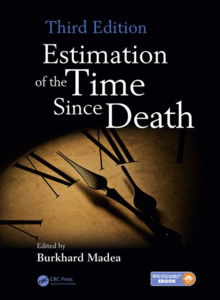
Estimation of the Time Since Death remains the foremost authoritative book on scientifically calculating the estimated time of death postmortem. Building on the success of previous editions which covered the early postmortem period, this new edition also covers the later postmortem period including putrefactive changes, entomology, and postmortem resonance spectroscopy.
Entomology and the radiocarbon test are now included, as they may be of significance in the early postmortem period. Because of the increasing importance of postmortem imaging, a chapter on cross-sectional imaging and the postmortem interval has been added. The book also describes in detail a new mathematical approach to narrow down the postmortem interval derived from the compound method (conditional probability in death time estimation).
A unique work of synthesis combining rigorous science with practical guidance, the book has been improved, updated, reformatted, and extended in scope. Redesigned in colour throughout, it continues to be an invaluable resource—and also the standard—for the estimation of the time since death.
Author
Burkhard Madea, MD, director, Institute of Forensic Medicine, University of Bonn, Germany.
Table of Contents
General Remarks on Estimating the Time Since Death
Historical Review on Early Work on Estimating of the Time Since Death
Supravitality in Tissues
Rigor Mortis
Postmortem Lividity
Postmortem Body Cooling and Temperature-Based Methods
Autolysis, Putrefactive Changes and Postmortem Chemistry
Gastric Contents and Time Since Death
Immunohistochemical Methods as an Aid in Estimating the Time Since Death
Practical Casework
Forensic Entomology
Radiocarbon Dating
Cross-Sectional Imaging and the Postmortem Interval
 -5%
-5%
 -5%
-5%
 -5%
-5%
 -5%
-5%
 -5%
-5%
 -5%
-5%
 -5%
-5%
 -5%
-5%
 -5%
-5%
 -5%
-5%