Descuento:
-5%Antes:
Despues:
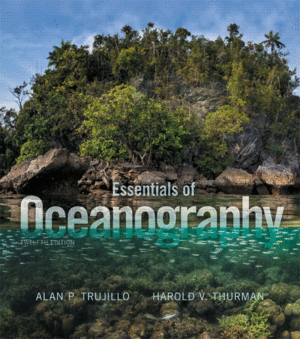
175,75 €For courses in Oceanography.
Oceanography: The Geological, Chemical, Biological, and Physical
Essentials of Oceanography guides students through the complexities of what lies beneath the ocean. With an interdisciplinary approach and accessible writing style, the text is engaging for students of all majors. The 12th Edition discusses the ocean’s biological, chemical, geological, and physical components for an in-depth understanding of this vast and elaborate topic. Complex concepts are made engaging with extensively revised art, new animations and the interdisciplinary connections that keep students interested and excited about the material.
Features
Hallmark interdisciplinary approach to oceanography
• Students are introduced to the biological, physical, chemical, and geological aspects of what lies beneath the sea, giving them comprehensive insight into its unique systems and properties.
• NEW! Climate Connection and Interdisciplinary Relationship icons highlight the overarching theme of climate change in the oceans, and the relationship between two or more sub-disciplines in oceanography: geological, chemical, physical, and biological.
• NEW! Interdisciplinary Relationship icons throughout show how various sections of the text relate to two or more of these sub-disciplines.
Brings Oceanography to Life Through Pedagogy
• NEW! SmartTables are engaging lecture videos created with information from a selected set of data in the chapter that clearly explain the relevance of each data set.
• NEW! SmartFigures are 3- to 4-minute video lessons in which oceanography experts explain difficult concepts and data. By scanning the accompanying QR code or typing in the short URL, students have a multitude of ways to learn from art and data tables, all designed to teach.
• NEW! Squidtoons, a comic-style call-out created by a team of graduate students at Scripps Institution of Oceanography in California, are featured in each chapter. These infographics highlight an important marine organism related to each chapter’s content. Each displays a recent discovery by researchers interestingly and captivatingly. By scanning the associated QR code or typing in the URL in the text, students can view the full cartoon.
• NEW! Enhanced illustration program includes new art that incorporates a research-proven teaching technique. By strategically placing annotations and labels within the key figures, the text helps students focus on the most relevant visual information and interpret complex art. Overall, nearly 90% of the entire book’s artwork is new or updated, including new figures visually summarize of essential processes and concepts.
• UPDATED! Diving Deeper boxes highlight captivating examples and stories related to chapter topics, and now include an additional assessment to make them assignable for faculty.
- Historical Features focus on historical developments in oceanography.
- Research Methods in Oceanography help students understand how oceanographic knowledge is obtained.
- Oceans and People looks at how humans interact with the ocean.
- Focus on the Environment emphasizes environmental issues, an increasingly important component of the book.
• Sometimes Students Ask features display common and often entertaining questions posed by real students, like “Why do my fingers get wrinkly when they are in the water for a long time?”
• UPDATED! Critical Thinking/Project Based Assessments have been added more frequently throughout the text, encouraging students to think deeply about chapter topics.
UPDATED! Difficult chapter topics have been revised for better student retention
• NEW! A Chapter on Marine Pollution introduces a timely and important topic to the text.
• REVISED! Chapters 1 (The Coriolis Effect), 2 (Waves), and 3 (Ecosystems/Fisheries) have been revised for clearer and more effective coverage.
• Accessible language and scientific etymons throughout the text clarify scientific terms.
Modular, objective-driven learning path
• Each chapter is organized into easily digestible chunks, making studying easier and assisting student learning.
- Chapters open with learning objectives called Essential Learning Concepts, which provide a roadmap to the chapter. Each section in the chapter focuses on one.
- Concept Check questions at the end of each section are designed to let students check their understanding of the Essential Learning Concept. Students ensure that they have a thorough understanding of key points before moving on to the next section.
- NEW! A Recap feature in each chapter summarizes essential concepts. This is a great tool for directing students' study and review.
- Each chapter ends with the Essential Concepts Review, which simplifies the study process. Also organized by section, this review highlights a key figure from the chapter and provides a summary of the chapter’s key concepts. It also includes study resources, Critical Thinking Questions, and NEW! Active Learning Exercises.
 -5%
-5%
 -5%
-5%
 -5%
-5%
 -5%
-5%
 -5%
-5%
 -5%
-5%
 -5%
-5%
 -5%
-5%
 -5%
-5%
 -5%
-5%