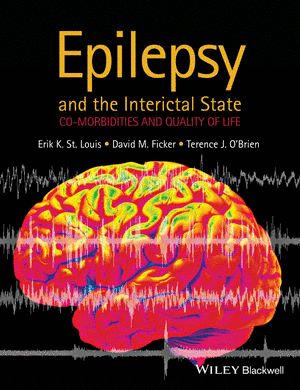
ST. LOUIS, E.; FICKER, D.; O'BRIEN, T.
Descuento:
-5%Antes:
Despues:
103,73 €Epilepsy care traditionally focuses on seizures, yet for most epilepsy sufferers, other interictal factors such as mood, cognitive abilities, and treatment adverse effects most influence how they feel and function day to day.
Epilepsy and the Interictal State is a practical and comprehensive text that covers quality of life issues, cognition and therapy, adverse effects of epilepsy treatments, mood state and psychiatric co-morbidity and general health aspects of epilepsy. Each chapter employs a standard structure providing background, epidemiology, pathophysiology, etiology, diagnosis, treatment, prognosis and further practical advice.
From an international team of expert editors and contributors, Epilepsy and the Interictal State is a valuable resource for specialist epileptologists and neurologists, as well as for neurosurgeons, neurology nurses, psychiatrists, family physicians and general practitioners.
Author Information
- Erik K. St Louis, Department of Neurology, Mayo Clinic, Rochester, MN, USA
- David M. Ficker, Department of Neurology, University of Cincinnati, Cincinnati, OH, USA
- Terence J. O’Brien, Departments of Medicine and Neurology, The Royal Melbourne Hospital, The University of Melbourne, Parkville, Vic, Australia.
Table of Contents
Section I: Quality of life and the interictal state in epilepsy
1 Quality of life in epilepsy: the key importance of the interictal state, 3
2 Comorbidities in epilepsy: range and impact, 7
3 Epilepsy, comorbidities, and consequences: implications for understanding and combating stigma, 15
Section II: Cognition and epilepsy
4 Causes and types of cognitive domain impairments in epilepsy, 29
Impairment of consciousness in epilepsy, 31
Ictal cognitive impairments due to nonconvulsive status epilepticus, 38
Memory and dysexecutive impairments in epilepsy, 45
Attention deficit/hyperactivity disorder, disordered attention, and epilepsy, 63
Behavioral and developmental disorders in epilepsy, 68
5 Cognitive effects of epilepsy therapies, 74
6 Autism and epilepsy, 88
7 Cognitive rehabilitation strategies in epilepsy, 94
Section III: Adverse effects of epilepsy therapies
8 Adverse effects in epilepsy: recognition, measurement, and taxonomy, 103
9 Clinically important antiepileptic drug interactions and their influence on adverse effects in epilepsy, 110
10 Minimizing the adverse effects of epilepsy therapies: principles and practice, 120
11 Idiosyncratic adverse side effects of antiepileptic drugs: risk, prevention, and counseling, 127
12 Antiepileptic drug therapy and fetal development, 136
Section IV: Mood state, psychiatric comorbidity, and epilepsy
13 Mood state, anxiety, and psychosis in epilepsy, 147
14 The contribution of sleep and anxiety disorders to quality of life in people with epilepsy, 159
15 Epilepsy and personality, 171
16 Psychogenic attacks and epilepsy, 183
Section V: General health and epilepsy 17
Obesity and epilepsy, 195
18 Epilepsy in the elderly: vascular disease, the aging brain, and selection of appropriate therapies, 203
19 Balance disorders and falls in epilepsy, 216
20 Bone health in epilepsy, 224
21 Sleep and epilepsy, 230
22 Use of complementary and alternative medicine in epilepsy, 241
23 Epilepsy and alcohol and substance abuse, 252
24 Driving, employment, and related issues in epilepsy, 258
Index, 267
 -5%
-5%
 -5%
-5%
 -5%
-5%
 -5%
-5%
 -5%
-5%
 -5%
-5%
 -5%
-5%
 -5%
-5%
 -5%
-5%
 -5%
-5%