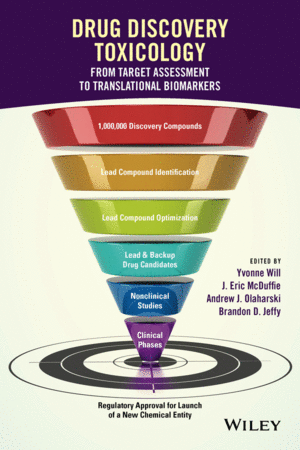
WILL, Y.; MCDUFFIE, J.; OLAHARSKI, A.
Descuento:
-5%Antes:
Despues:
173,39 €ART I INTRODUCTION 1
1 Emerging Technologies and their Role in Regulatory Review 3
• PART II SAFETY LEAD OPTIMIZATION STRATEGIES 13
2 Small-Molecule Safety Lead Optimization 15
3 Safety Assessment Strategies and Predictive Safety of Biopharmaceuticals and Antibody Drug Conjugates 27
4 Discovery and Development Strategies for Small Interfering Rnas 39
• PART III BASIS FOR IN VITRO–IN VIVO PK TRANSLATION 53
5 Physicochemistry and the Off-Target Effects of Drug Molecules 55
6 The Need for Human Exposure Projection in the Interpretation of Preclinical In Vitro and In Vivo ADME Tox Data 67
7 A DME Properties Leading to Toxicity 82
• PART IV Predicting Organ Toxicity 93
8 Liver 95
9 Cardiac 130
10 Predictive In Vitro Models for Assessment of Nephrotoxicity and Drug–Drug Interactions In Vitro 160
11 Predicting Organ Toxicity In Vitro: Bone Marrow 172
12 Predicting Organ Toxicity In Vitro: Dermal Toxicity 182
13 In Vitro Methods in Immunotoxicity Assessment 193
14 Strategies and Assays for Minimizing Risk of Ocular Toxicity during Early Development of Systemically Administered Drugs 201
15 Predicting Organ Toxicity In Vivo—Central Nervous System 214
16 Biomarkers, Cell Models, and In Vitro Assays for Gastrointestinal Toxicology 227
17 Preclinical Safety Assessment of Drug Candidate-Induced Pancreatic Toxicity: From an Applied Perspective 242
• PART V A DDRESSING THE FALSE NEGATIVE SPACE—INCREASING PREDICTIVITY 261
18 Animal Models of Disease for Future Toxicity Predictions 263
19 The Use of Genetically Modified Animals in Discovery Toxicology 298
20 Mouse Population-Based Toxicology for Personalized Medicine and Improved Safety Prediction 314
• PART VI STEM CELLS IN TOXICOLOGY 331
21 Application of Pluripotent Stem Cells in Drug-Induced Liver Injury Safety Assessment 333
22 Human Pluripotent Stem Cell-Derived Cardiomyocytes: A New Paradigm in Predictive Pharmacology and Toxicology 346
23 Stem Cell-Derived Renal Cells and Predictive Renal In Vitro Models 365
• PART VII CURRENT STATUS OF PRECLINICAL IN VIVO TOXICITY BIOMARKERS 385
24 Predictive Cardiac Hypertrophy Biomarkers in Nonclinical Studies 387
25 Vascular Injury Biomarkers 397
26 Novel Translational Biomarkers of Skeletal Muscle Injury 407
27 Translational Mechanistic Biomarkers and Models for Predicting Drug-Induced Liver Injury : Clinical to In VitroPerspectives 416
• PART VIII Kidney Injury Biomarkers 429
28 Assessing and Predicting Drug-Induced Kidney Injury, Functional Change, and Safety in Preclinical Studies in Rats 431
29 Canine Kidney Safety Protein Biomarkers 443
30 Traditional Kidney Safety Protein Biomarkers and Next-Generation Drug-Induced Kidney Injury Biomarkers in Nonhuman Primates 446
31 Rat Kidney MicroRNA Atlas 448
32 MicroRNAs as Next-Generation Kidney Tubular Injury Biomarkers in Rats 450
33 MicroRNAs as Novel Glomerular Injury Biomarkers in Rats 452
34 Integrating Novel Imaging Technologies to Investigate Drug-Induced Kidney Toxicity 454
35 In Vitro to In Vivo Relationships with Respect to Kidney Safety Biomarkers 458
36 Case Study: Fully Automated Image Analysis of Podocyte Injury Biomarker Expression in Rats 462
37 Case Study: Novel Renal Biomarkers Translation to Humans 466
38 Case Study: Microrn as as Novel Kidney Injury Biomarkers in Canines 468
39 Novel Testicular Injury Biomarkers 471
• PART IX Best Practices in Biomarker Evaluations 475
40 Best Practices in Preclinical Biomarker Sample Collections 477
41 Best Practices in Novel Biomarker Assay Fit-for-Purpose Testing 481
42 Best Practices in Evaluating Novel Biomarker Fit for Purpose and Translatability 489
43 Best Practices in Translational Biomarker Data Analysis 495
44 Translatable Biomarkers in Drug Development: Regulatory Acceptance and Qualification 500
• PART X Conclusions 509
45 Toxicogenomics in Drug Discovery Toxicology: History, Methods, Case Studies, and Future Directions 511
46 Issue Investigation and Practices in Discovery Toxicology 530
As a guide for pharmaceutical professionals to the issues and practices of drug discovery toxicology, this book integrates and reviews the strategy and application of tools and methods at each step of the drug discovery process.
• Guides researchers as to what drug safety experiments are both practical and useful
• Covers a variety of key topics – safety lead optimization, in vitro-in vivo translation, organ toxicology, ADME, animal models, biomarkers, and –omics tools
• Describes what experiments are possible and useful and offers a view into the future, indicating key areas to watch for new predictive methods
• Features contributions from firsthand industry experience, giving readers insight into the strategy and execution of predictive toxicology practices.
Author Information
• Yvonne Will, PhD, is a Senior Director and the Head of Science and Technology Strategy, Drug Safety Research and Development at Pfizer, Connecticut, USA. She co-edited the book Drug-Induced Mitochondrial Dysfunction, published by Wiley in 2008.
• J. Eric McDuffie, PhD, is the Director of the Discovery / Investigative Toxicology and Laboratory Animal Medicine groups at Janssen Research & Development, California, USA.
• Andrew J. Olaharski, PhD, is an Associate Director of Toxicology at Agios Pharmaceuticals, Massachusetts, USA.
• Brandon D. Jeffy, PhD, is a Senior Principal Scientist in the Exploratory Toxicology division of Nonclinical Development at Celgene Pharmaceuticals, California, USA.
 -5%
-5%
 -5%
-5%
 -5%
-5%
 -5%
-5%
 -5%
-5%
 -5%
-5%
 -5%
-5%
 -5%
-5%
 -5%
-5%
 -5%
-5%